


Where to Find Obituary Notices in Massachusetts
Finding obituary notices in Massachusetts can be straightforward if you know where to look. Obituaries provide more than just announcements - they offer insights into family history, property details, and probate records. Whether you're researching for genealogy or legal purposes, here are the best ways to locate these records:
- Online Databases: Platforms like Legacy.com, FamilySearch, and GenealogyBank provide access to millions of Massachusetts obituaries. Legacy.com focuses on recent notices, while FamilySearch offers free access to historical records. GenealogyBank includes over 110 Massachusetts newspapers with archives dating back to 1690.
- State and Local Archives: The Massachusetts State Archives holds death records from 1841–1930, while the Registry of Vital Records maintains records from 1931 onward. Local libraries, like the Boston Public Library, also offer extensive newspaper archives and microfilm collections.
- Funeral Homes and Cemeteries: Funeral home websites often publish recent obituaries, and cemetery records provide burial details. Resources like the Jewish Cemetery Association of Massachusetts and Find a Grave are useful for specific searches.
- Newspapers: Major newspapers like The Boston Globe and Boston Herald maintain searchable archives, often available through library databases or subscription services like Newspapers.com.
- Libraries and Genealogical Societies: Public libraries and organizations like the New England Historic Genealogical Society house specialized collections, including church records, cemetery indexes, and historical newspapers.
For quick access, start with free online tools like FamilySearch or Legacy.com. For older records, visit local archives or libraries. Combining online and offline methods ensures thorough research.
::: @figure 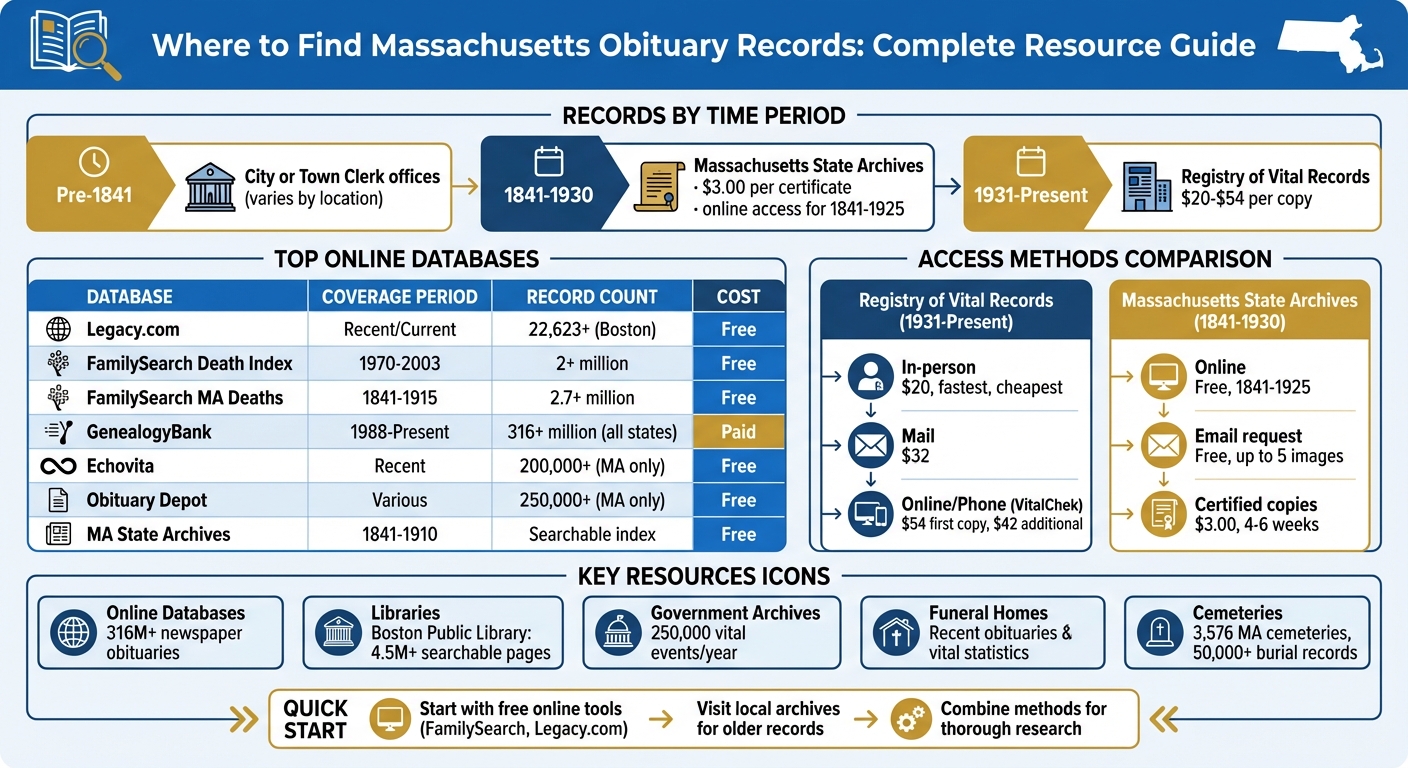 {Massachusetts Obituary Records: Access Points by Time Period and Cost}
:::
{Massachusetts Obituary Records: Access Points by Time Period and Cost}
:::
Online Resources for Massachusetts Obituaries
The internet has revolutionized how we access obituary records, making it possible to explore millions of entries with just a few clicks. In Massachusetts, both free and subscription-based platforms provide access to records spanning different time periods. These resources offer a gateway to understanding the wealth of information available for obituary searches in the state.
Statewide Obituary Databases
Several platforms compile obituary notices from across Massachusetts, offering a range of access options. Legacy.com is a go-to resource for recent obituaries, partnering with local newspapers to provide notices from the last 30 days and beyond. Their "Boston Remembers" section alone includes over 22,623 obituaries for the Boston area [10]. Another excellent option is FamilySearch, which offers free access (registration required) to Massachusetts collections such as the Death Index (1970–2003) with over 2 million records, Massachusetts Deaths (1841–1915) with more than 2.7 million records, the Town Deaths Index (1640–1961), and State Vital Records (1638–1927) [6].
For those seeking extensive archives, GenealogyBank stands out, featuring over 110 Massachusetts newspapers, some dating back to 1690, alongside a modern obituary collection from 1988 to today. Across all states, this database includes over 316 million newspaper obituaries [12].
Specialized platforms like Echovita and Obituary Depot focus specifically on Massachusetts. Echovita hosts more than 200,000 state-specific obituaries, while Obituary Depot offers an index of over 250,000 notices [6]. Additionally, the Massachusetts State Archives provides a searchable online index for deaths from 1841 to 1910, making it an essential tool for 19th-century records.
| Database Name | Coverage Period | Record Count | Access Type |
|---|---|---|---|
| Legacy.com | Recent/Current | 22,623+ (Boston area) | Free |
| FamilySearch MA Death Index | 1970–2003 | 2+ million | Free |
| FamilySearch MA Deaths | 1841–1915 | 2.7+ million | Free |
| GenealogyBank | 1988–Present | 316+ million (all states) | Subscription |
| Echovita | Recent | 200,000+ (MA only) | Free |
| Obituary Depot | Various | 250,000+ (MA only) | Free |
| MA State Archives Index | 1841–1910 | N/A | Free |
Key Note: Many platforms distinguish between "obituaries" and "death notices." If you can't locate a name, it’s possible the individual received only a brief death notice. In such cases, searching through actual newspaper pages might be necessary instead of relying solely on indexed databases.
Newspaper Websites with Obituary Archives
Major newspapers also maintain their own digital archives. For example, The Boston Globe has digitized 4,529,640 searchable pages from 1872 through 2025, accessible via Newspapers.com (subscription required) [9][11]. Alternatively, the Boston Public Library Obituary Database offers a free resource, indexing the Boston Evening Transcript (1932–1941), The Boston Globe (1932–1941 and 1953–2010), and the Boston Herald (1953–2010) [1].
Ancestry.com provides another option for accessing The Boston Globe obituaries through its subscription service, with the collection updated as recently as January 25, 2026 [11].
For historical records predating 1930, Newspapers.com’s archive of The Boston Globe - dating back to 1872 - is an excellent starting point. For obituaries from 1932 to 2010, the free Boston Public Library database is a practical first step before considering paid options. For more recent obituaries, Legacy.com is an easily accessible choice.
Genealogy and Historical Websites
Genealogy platforms expand obituary searches by connecting them to broader family history records. Ancestry.com combines its U.S. Newspapers.com Obituary Index (1800s to present) with the Massachusetts Death Records Index (1970–2003), allowing users to cross-reference obituaries with vital records, census data, and family trees.
The New England Historic Genealogical Society (NEHGS), operating under the name American Ancestors, offers an extensive library of over 200,000 volumes. This includes cemetery records, church records, wills, probate records, and a dedicated newspaper collection [3]. Probate research can be particularly fruitful here, as obituaries often include details about heirs and their locations.
Community-specific resources help fill gaps in broader databases. For example, the Jewish Cemetery Association of Massachusetts provides a burial search database with over 50,000 records [7][8]. The Congregational Library & Archives focuses on records of Congregational Christian ministers and missionaries dating back to the 1600s [13]. Additionally, the Massachusetts Vital Records Project indexes early records (1600–1849), including gravestone inscriptions and newspaper articles [6].
These resources are invaluable for painting a fuller picture of family histories. As noted by GenealogyBank:
"a 'story' of a person's life, including their values, community contributions, and detailed family trees that may not be available in official death certificates" [12].
Here’s a helpful tip: Many subscription services, such as Ancestry Library Edition, can be accessed for free at Boston Public Library locations. This provides on-site access to premium tools without requiring a personal subscription.
Public Libraries and Archives in Massachusetts
Massachusetts is home to some of the most impressive newspaper and genealogical collections in the United States. At the heart of this treasure trove is the Boston Public Library (BPL) Central Library in Copley Square. As the headquarters for the Massachusetts Newspaper Program, it boasts one of the largest newspaper collections in the country [16]. Beyond newspapers, the library’s Local and Family History Collection features over 30,000 items, covering a timeline from the 17th to 21st centuries [18]. These resources pair perfectly with online databases and government archives, making obituary research incredibly thorough.
Library Collections and Microfilm Archives
Massachusetts libraries often store historical newspaper collections on microfilm, which requires hands-on examination [2][17]. At the BPL, researchers can request up to six microfilm reels at the Washington Desk in the McKim Building. Requests must specify a narrow date range, such as "March 1–15, 1890", and retrieval usually takes 10 to 30 minutes [17].
Modern tools like the ScanPro 3000 simplify the process by allowing users to save digital files directly to a USB drive or email, minimizing the need for paper copies [15][17]. For those who prefer physical copies, they’re available for $0.20 per page [15]. Additionally, libraries offer complimentary access to premium genealogy databases like Ancestry Library Edition and American Ancestors, though these services are typically only available on-site [2][14].
Beyond newspapers, many libraries house "Tan Books", which are published volumes of vital records (births, marriages, and deaths) for Massachusetts towns, focusing mainly on pre-1850 records [2][14]. Other valuable resources include historical city directories and the Boston Evening Transcript genealogy columns (1911–1941), which are useful for estimating death dates when exact information is unavailable [2][16]. Libraries also maintain neighborhood-specific and ethnic newspapers, such as The Jewish Advocate and The Irish Times, which often contain records not found in major publications [15][16]. These unique collections serve as powerful tools for in-depth research and can guide researchers toward additional resources through genealogical societies.
Genealogical and Historical Societies
Across Massachusetts, local historical and genealogical societies enrich research efforts with specialized collections that complement library archives. These societies often safeguard documents like cemetery and church records, family histories, and town-specific materials that may not be included in larger databases. Many of these organizations welcome researchers by appointment and provide expert guidance on local resources, including vital records. By bridging the gap between library collections and official government archives, these societies offer an invaluable layer of support for anyone diving into genealogical research.
Government Resources for Death Records
Massachusetts death records are crucial for legal matters like probate and estate settlement, as well as for genealogical research [23]. These certified documents provide verified details such as death dates and locations, which are essential for legal proceedings in Probate and Family Court and for researchers seeking accurate historical data [23].
Massachusetts Registry of Vital Records
The Massachusetts Registry of Vital Records and Statistics (RVRS) is responsible for maintaining official death certificates from 1931 onward [5]. Unlike obituaries, which are more informal announcements, death certificates are public records that anyone can request. This accessibility makes them vital for both legal purposes and genealogical studies. Each year, RVRS handles around 250,000 vital events, including births, deaths, and marriages [21].
The cost and processing time for record requests depend on the method chosen:
- In-person requests: Available at the RVRS office (150 Mount Vernon St., 1st Floor, Dorchester, MA 02125), these are the most affordable at $20 per copy. The office operates Monday through Friday, 8:45 a.m. to 4:45 p.m. [5].
- Mail requests: Priced at $32 per copy.
- Online or phone orders: Processed through the VitalChek portal, these cost $54 for the first copy and $42 for each additional copy [19].
For genealogical purposes, non-certified copies can be accessed during specific research hours: Monday and Thursday from 1:00 p.m. to 4:00 p.m., and Tuesday and Friday from 9:00 a.m. to 12:00 p.m. [5]. A valid photo ID is required. If no record is found, the RVRS provides a "Negative Statement", which can be necessary for creating delayed records.
These official records play a key role in probate verification, complementing obituary information and other legal documents.
County and State Archives
For deaths prior to 1931, you’ll need to turn to alternative sources. The Massachusetts State Archives holds death records from 1841 to 1930, while records before 1841 are maintained by city or town clerks where the death occurred [20].
The State Archives offers a convenient option for researchers: digital copies of vital records from 1841 to 1925 are available on their website [20]. For records between 1841 and 1930 that aren’t online, you can email archives@sec.state.ma.us to request up to five free digital images [20]. Certified copies from this period are just $3.00 each, though processing takes 4 to 6 weeks [20]. Payments must be made via cash or check payable to the "Commonwealth of Massachusetts", as credit cards and electronic payments are not accepted [20].
| Record Period | Primary Repository | Cost | Access Methods |
|---|---|---|---|
| Pre-1841 | City or Town Clerk | Varies by location | Mail, In-person |
| 1841–1930 | Massachusetts State Archives | $3.00 per certificate | Online (1841–1925), Email, Mail |
| 1931–Present | Registry of Vital Records (RVRS) | $20–$54 per copy | Online, Phone, Mail, In-person |
For probate-related research, the Massachusetts Judicial Archives Collection is another valuable resource. It includes probate and civil case records alongside vital records, offering crucial documentation for verifying estates and family lineages [22]. These certified records add a layer of accuracy and reliability to your research, supporting other sources like obituaries and probate documents.
Funeral Homes and Cemetery Records
In addition to online databases and government records, funeral home and cemetery records provide verified details that are crucial for probate research. These records often fill in gaps, offering reliable insights into both recent and historical deaths.
Funeral Home Websites and Directories
Funeral homes are legally required to report vital statistics, making them a timely resource for information on recent deaths [26]. They often publish obituaries on their websites, which include details about the deceased and upcoming memorial services. This can be particularly helpful when obituaries haven’t yet appeared in newspapers or other online databases.
If you’re searching for a specific funeral home, city-specific directories can help you locate the right provider quickly. For instance, directories covering major Massachusetts cities like Boston, Worcester, Springfield, Lowell, and Cambridge are widely available [24][25][27]. If an online obituary isn’t listed, contacting the funeral home directly might yield the information you need. Even when formal obituaries are not published, funeral homes maintain archives of reported vital statistics [26].
For those conducting historical research, some funeral homes, such as Lewis in Nantucket, have digitized older records, making them available as downloadable PDFs [7].
When funeral home records fall short, cemetery records can serve as another reliable source for essential details.
Cemetery and Gravestone Records
Cemetery records are invaluable, especially when researching older deaths where funeral home data may be incomplete [7]. These records typically provide key information such as exact death dates, birth dates, burial locations, and family connections - especially when relatives are buried in adjoining plots.
Massachusetts offers several specialized resources for cemetery records. The Jewish Cemetery Association of Massachusetts maintains a searchable database with over 50,000 burial entries [7]. Similarly, the Catholic Cemetery Association of the Archdiocese of Boston provides records for Essex, Middlesex, and Suffolk counties [7]. Local historical societies also contribute, with projects like the Barnstable County Gravestone Records (1683–1860) and the Falmouth Genealogical Society's obituary index offering additional insights [7].
For broader searches, online platforms like Find a Grave catalog 3,576 cemeteries across Massachusetts, complete with memorial counts and headstone photographs [28]. Another resource, Interment.net, organizes burial records by county and city, pulling data from cemetery offices, churches, and municipal records [29]. For example, Springfield Cemetery alone has 17,863 records available in the Interment.net archive [29].
Together, funeral home and cemetery records create a comprehensive resource for anyone conducting probate or genealogical research.
Offline Methods for Finding Obituaries
While online resources are convenient, offline methods like visiting libraries and archives can uncover historical obituaries that might not be available online. These approaches often provide access to original records and local archives that are sometimes overlooked.
Visiting Local Libraries and Archives
Libraries and archives are treasure troves for historical research. For instance, the Boston Public Library Central Library offers extensive microfilm archives in its Research Services department. To make the most of your visit, narrow down your search to a specific date range (e.g., "March 1–15, 1890"). Staff will provide a limited number of microfilm reels based on your request. Keep in mind that microfilm isn’t keyword searchable - you’ll need to manually browse through issues, starting with the date of death and checking several days after [17] [2].
"The majority of the library's newspaper collection is on microfilm, which is searched manually and is not keyword searchable. When you request microfilm, you request specific newspaper titles and dates." - Boston Public Library [2]
Another excellent resource is the Massachusetts State Archives, located at 220 Morrissey Boulevard, Boston. Here, you’ll find vital records dating from 1841 to 1930 available on microfilm readers. Be sure to bring a photo ID for registration and a USB drive to scan microfilm images at no cost. Note that vault pulls end at 4:00 PM, and the reading room closes at 4:30 PM [30] [31].
If you’re researching death records from 1926 onward, head to the Massachusetts Registry of Vital Records and Statistics at 150 Mount Vernon Street in Dorchester. Fees for accessing these records range from $20.00 to $62.50, depending on the type of request [4] [14]. For deaths prior to 1841, you’ll need to contact the town or city clerk’s office where the death occurred [4] [14].
For records not available at libraries or archives, reaching out directly to newspaper offices can be another valuable strategy.
Contacting Newspaper Offices Directly
If library archives don’t yield the results you’re looking for, contacting newspaper offices directly can help you locate additional obituary records. Before reaching out, gather key details like the deceased's full name, exact date of death, and the city or town where they lived or passed away. This information will help narrow down the search and identify the right local publication [2].
Many major newspapers in Massachusetts now outsource archive requests to third-party platforms. For example, The Boston Globe directs historical obituary searches to bostonglobe.newspapers.com [32] [34]. For smaller local newspapers, archives are often managed by public libraries. For instance, requests for the Lynn Item (covering 1995 to the present) should be sent to refquest@noblenet.org at the Lynn Public Library [33].
When making your request, it’s important to specify whether you’re looking for a "death notice" (a paid classified ad) or an "obituary" (a staff-written news piece), as these are archived separately [32] [2]. If you’re unsure of the exact publication date, provide a date range of several days following the death [2]. For high-quality copies of original newspaper files, you can contact the Boston Public Library's Archival Center by emailing ask@bpl.org. However, keep in mind that this process can take about two weeks [35].
Conclusion
Tracking down obituary notices in Massachusetts involves blending online tools with traditional research methods. Begin with free digital platforms like Legacy.com or FamilySearch to quickly find recent obituaries or narrow down death dates. For older records, delve into the extensive archives at the Boston Public Library or the Massachusetts State Archives, which house collections dating back to the 1800s.
Having the date and location of death on hand can make your search much smoother. This information helps pinpoint the right resources to explore, as records are often organized by time period and location. Understanding how these sources are structured can save you a lot of effort.
The best strategy combines online databases, which are searchable by keywords, with focused offline research at local libraries and archives. It’s also a good idea to check records in both the city where the death occurred and the deceased’s hometown, as obituaries were often published in multiple places [2]. Together, these methods create a thorough approach to finding the information you need.
Whether you're looking into recent deaths or piecing together family history from centuries ago, Massachusetts provides a wealth of resources - from government archives to digital tools - to help you locate obituary notices efficiently.
FAQs
::: faq
Where can I find free obituary records in Massachusetts?
If you're searching for free obituary records in Massachusetts, there are several valuable resources you can tap into. For starters, the Boston Public Library hosts an extensive obituary database that covers major Boston newspapers. This makes it an excellent resource for anyone diving into historical research. They also provide helpful guides for exploring genealogy and newspaper archives, offering even more depth for your search.
Another great option is the Massachusetts Obituaries website. It organizes obituaries by county and city, often linking directly to local newspaper archives. For more recent notices, Legacy.com is a popular platform that regularly updates obituaries from newspapers and funeral homes throughout the Boston area.
If your research needs to go beyond specific cities, Cyndi's List is a fantastic tool. It compiles links to a wide range of Massachusetts obituary collections, including online archives and newspaper indexes. All these resources are free to use and are widely trusted for genealogical and historical research across the state. :::
::: faq
Where can I find Massachusetts death records from before 1931?
You can access Massachusetts death records from before 1931 through a few key resources. The Massachusetts Archives holds vital records spanning 1841 to 1930. Digital copies for records from 1841 to 1925 are available online. For records not found online, you can request digital or certified copies via email, mail, or by visiting in person. Keep in mind that processing requests usually take about 4–6 weeks.
For deaths prior to 1841, records are often preserved in local town archives or can be found through genealogical tools like FamilySearch, which includes documents dating back to the 1600s. Since statewide death registration only started in 1841, earlier records are typically part of town-specific collections or family history databases.
To sum up, use the Massachusetts Archives for records from 1841–1930, and explore genealogical platforms or town archives for older records. :::
::: faq
How can I find older obituaries in Massachusetts without using the internet?
If you're searching for older obituaries in Massachusetts and prefer offline methods, several resources can help. Local libraries, historical societies, and archives often keep microfilmed or printed copies of newspapers. For instance, the Boston Public Library and the Massachusetts State Archives house extensive collections of newspapers and obituary records available for in-person research.
Another option is to visit the offices of local newspapers. Many, including larger publications like the Boston Globe, maintain physical archives or microfilm copies of past editions. Some even offer research assistance or access through interlibrary loan services. These offline options are particularly helpful for locating obituaries from periods before the internet or when online access isn't an option. :::


