


How Digital Tools Improve Probate Workflows
Probate processes are notoriously slow and outdated, often taking up to 20 months and costing 3–7% of an estate's value. Manual tasks like asset discovery, data entry, and compliance with varying rules create inefficiencies and errors. Digital tools are changing this by automating repetitive tasks, reducing paperwork, and improving accuracy.
Key highlights:
- 80% of probate applications in the UK were filed digitally by late 2024, cutting processing times from 15 weeks to 2 weeks.
- Automated systems save 3+ hours per case and reduce errors in forms and calculations.
- AI tools handle asset documentation with 98% accuracy, flagging unusual financial activity and reconstructing records in minutes.
- Secure platforms centralize data, streamline communication, and ensure compliance with encryption standards.
Gavel's No-Setup Automated Legal Forms: Built for Probate, Estate Planning, and Family Law Attorneys
sbb-itb-fc184bb
How Case Management Systems Improve Efficiency
The shift from manual processes to digital tools has made case management systems essential for simplifying probate workflows. These systems centralize case data using dashboards that give supervisors instant access to case details. Tim Wilson of Hughes Parry Solicitors highlights the benefits:
"As a supervisor it's great because I can get an overview immediately of each case we're working on... everything is captured on the case's dashboard" [9].
Features like visual tiles for assets, such as bank accounts and properties, make it easier to spot missing information [9][12].
Beyond these operational upgrades, research provides compelling evidence of how these systems enhance workflow efficiency.
Research Findings on Workflow Improvements
Data reveals that 66% of legal professionals lose more than half their time manually searching for asset information [8]. The administrative load is staggering: 80% of probate cases involve sending at least 10 printed letters, and in 10% of cases, firms send over 50 [8].
In March 2024, Macnabs Solicitors adopted Exizent software to handle around 10 new cases per month. Partner Sarah Mitchell shared that the platform allowed less experienced staff to contribute earlier in the process. By automating IHT400 and Scottish C1 Court forms, the firm significantly cut down on the "man-hours" typically required for these tasks [12].
These advancements in efficiency lead directly to quicker case resolutions.
Faster Case Processing Times
The time savings are both measurable and impactful. Probate software can save over 3 hours per case by automating tasks like inheritance tax forms, court forms, and estate accounts [10]. For example, in May 2022, Jack Parton used Exizent’s autofill feature to reduce the time needed for IHT400, schedules, and PA1A forms from 3.5–4 hours to just 20 minutes [13]. Parton remarked:
"To go from three and a half to four hours down to 20 minutes is a huge advantage!" [13]
This efficiency isn’t just about saving time - it also benefits clients. Simon Levy of Frank Brazell & Partners, who transitioned to digital tools after 20 years of manual work in July 2022, emphasized that time-based client billing meant these efficiencies lowered costs for grieving families [11]. These advancements are driving faster, more accurate, and cost-efficient probate processes, marking a significant step in the digital transformation of the industry.
AI and Automation for Asset Documentation
AI advancements are bringing the same efficiency improvements seen in case management to asset documentation, a traditionally time-consuming aspect of probate. By replacing manual data entry with AI-driven tools, the process has become faster and less prone to errors. These technologies are reshaping how asset documentation is handled, reducing mistakes and simplifying workflows.
How AI Reduces Documentation Errors
AI tools like Optical Character Recognition (OCR) and Natural Language Processing (NLP) are game changers for extracting financial data from challenging documents like poor-quality scans or faxes. They can automatically organize key details such as income, recurring expenses, and significant withdrawals, creating a clear and unified financial timeline [14][15].
The accuracy of these tools is impressive, with estate documentation systems achieving a 98% accuracy rate [17]. Specialized probate software takes this a step further by using "Single Source of Truth" mapping to auto-fill related court forms, completely eliminating manual entry mistakes [2][5].
David Barnard, CEO of Luminary, highlights the user-friendly nature of these AI tools:
"Luminary AI makes bulk data extraction easy, from nearly any kind of document. This isn't a black box. Our human-in-the-loop AI workflow helps our users better understand the information they are working with" [17].
Beyond reducing errors, AI can also detect patterns that might go unnoticed by humans. For instance, it can flag unusual financial activity, such as suspicious transfers or large withdrawals before death. This information can be crucial for uncovering undue influence or locating hidden assets [14].
Automating Repetitive Tasks
With improved accuracy, automation takes on the repetitive tasks that once slowed down document processing. AI tools can process years' worth of financial records in under an hour, a job that would typically take days of manual effort [14]. For example, studies show platforms like Gavel can cut drafting time by 90% [18].
One practical example is CounselPro, available for $100 per month and capable of processing up to 5,000 pages. A fiduciary managing an estate with multiple accounts used the platform to reconstruct the financial history of the decedent. The AI extracted transaction data and flagged large withdrawals, completing in under an hour what would have taken a paralegal several days. The result was a detailed, court-ready report with source citations [14].
Tracy Troyer, a partner at Troyer & Good, shared how her firm uses Gavel to simplify legal document preparation:
"You don't have to have a law degree to complete [the forms] . . . you don't need to know what per stirpes means . . . and that was a big thing about Gavel that was appealing" [18].
Automation also tackles the complex calculations required for probate filings, such as summing asset schedules or calculating executor fees. By eliminating manual math errors - one of the main reasons filings are rejected - these tools ensure smoother processing. Since data is digitized from the start, staff can simultaneously review assets and prepare filings as client information comes in, significantly speeding up the "time to file" [5].
For professionals handling probate cases in Massachusetts, services like LeadList.Pro enhance these automation tools by providing weekly updates on probate cases, complete with AI-driven insights and property details. This integration allows firms to focus on opportunities while their automated systems manage documentation seamlessly, setting a higher benchmark for efficiency in asset valuation and case management.
Document Management and Secure Data Sharing
Modern platforms have revolutionized how probate documents are handled by centralizing and securing them in one place. Probate workflows often involve a mountain of paperwork - death certificates, wills, insurance forms, financial statements, and court filings. Digital platforms tackle this by offering a centralized repository where executors and attorneys can securely store and access all documents, cutting down on the hassle of sifting through paper files and email threads [19][4].
Faster Document Collection
The move from paper-based questionnaires to digital intake portals has completely changed how firms gather information. Clients now submit family and asset details through secure online forms, ensuring data is structured and accurate. Gone are the days of staff manually extracting information from PDFs.
The efficiency gains are hard to ignore. Probate software often uses "one-to-many" data mapping, where a single entry - like a date of death - automatically fills in all the necessary fields across various court forms. As Philip King from Snapform AI puts it:
"the most significant efficiency killer in probate is re-typing data" [5]
By eliminating repetitive data entry, firms can file and process cases much faster. For example, in the UK, this shift to digital intake cut paper usage by 25 million sheets. Digital application rates jumped from 17% in fiscal year 2019/2020 to 80% by late 2024. Even more impressive, the open caseload dropped dramatically - from a peak of 97,000 cases in August 2023 to just 9,856 by January 2025 [1]. This streamlined process not only speeds things up but also sets the foundation for secure data sharing among all involved parties.
Secure Sharing Between Stakeholders
Efficient data collection is only part of the equation - keeping sensitive information secure is just as important. Leading cloud-based probate platforms use bank-grade encryption and comply with top security standards like SOC 2, ISO 27001, and GDPR [5][7]. These systems replace risky email attachments with centralized portals, where authorized stakeholders - such as attorneys, beneficiaries, and family members - can access up-to-date information without worrying about document loss or tampering.
To further enhance security, access controls ensure that only authorized individuals can view case data. Comprehensive audit trails track every entry, expense, and distribution, helping to prevent disputes and shield executors from liability [20]. Additionally, the UK's digital transformation has replaced in-person oaths with a "digital statement of truth", allowing stakeholders to complete this step from home, saving time and travel [1].
For professionals in Massachusetts, tools like LeadList.Pro integrate seamlessly with these systems by providing weekly updates on probate cases, complete with property and contact details. This combination of secure document management and proactive case tracking helps firms stay organized, protect sensitive data, and uncover new opportunities - all while maintaining efficient workflows.
Improved Accuracy in Asset Valuation
With advancements in documentation and process automation, digital tools are now offering more precise and reliable asset valuations.
Accurate asset valuation is a cornerstone of the probate process. Mistakes in this area can lead to tax complications, disputes among beneficiaries, and even legal challenges. By leveraging advanced AI models and blockchain technology, these tools are replacing manual methods with solutions that provide both precision and transparency.
Blockchain for Asset Verification
Blockchain technology ensures a tamper-proof, transparent record by using decentralized verification. Data is stored across multiple nodes, and any changes require consensus, making it nearly impossible to manipulate fraudulently [22]. This level of transparency benefits executors and beneficiaries alike, as they can track real-time updates on asset transfers and value changes through a shared ledger. It fosters trust and confidence among all parties. The NYC Probate Blog highlights this advantage:
"Since each transaction on a blockchain is transparent and immutable, it provides a reliable and tamper-proof record of documents." [22]
Smart contracts take this a step further by automating asset distribution. These self-executing contracts follow the terms outlined in a will, transferring assets automatically once specific conditions - like the verification of death - are met. This reduces human error and minimizes the potential for disputes [21][22].
AI-Powered Valuation Models
AI-powered tools are revolutionizing asset valuation by delivering fast and accurate results while cutting down on manual labor. For example, CounselPro’s AI-driven OCR technology can extract financial data from low-quality scans and faxes, reconstructing a decedent’s financial history in just minutes instead of weeks [14]. The platform processes data from over 10,000 financial institutions simultaneously, categorizing transactions to create a detailed timeline for accurate distribution calculations [14]. According to CounselPro:
"What used to take weeks now takes minutes. You get complete transparency into the decedent's financial life." [14]
Specialized probate platforms also streamline the valuation of securities. Integrated tools can instantly determine the fair market value of stocks and bonds as of the date of death, saving hours of research [16]. AI models meticulously analyze financial records, ensuring that even estates with complex holdings are evaluated comprehensively. This level of precision helps avoid disputes among beneficiaries and establishes defensible valuations for tax purposes [3].
Digital tools like these are reshaping the probate process, making it faster, more accurate, and far less prone to error.
Measurable Benefits of Digital Tools in Probate
::: @figure 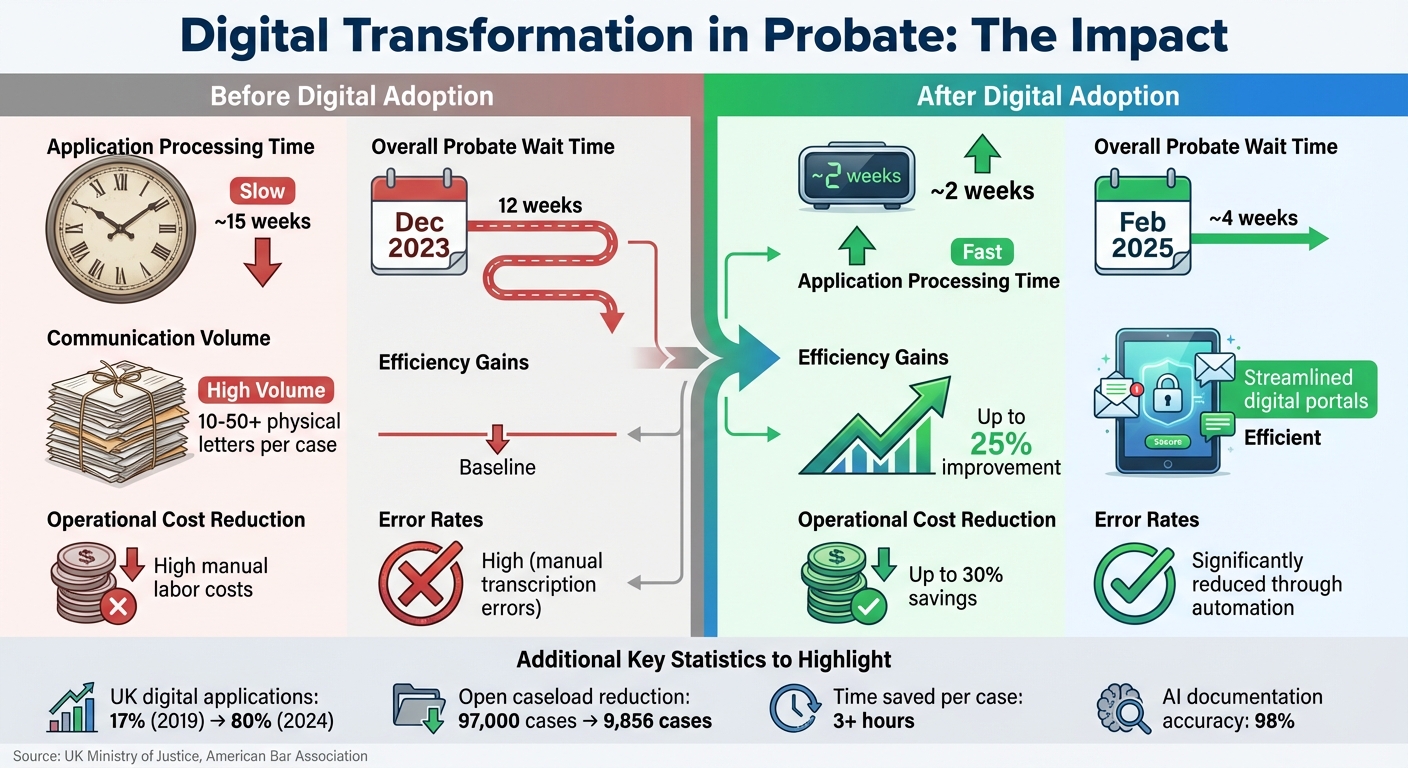 {Digital vs Manual Probate Processing: Before and After Metrics}
:::
{Digital vs Manual Probate Processing: Before and After Metrics}
:::
Digital workflows in probate have brought clear improvements in speed, cost, and accuracy.
Sarah Sackman KC, Justice Minister, highlights that digital applications now take "on average just over two weeks to complete", compared to the 15 weeks required for paper applications [23]. The overall probate wait time has also seen a dramatic drop, going from 12 weeks in December 2023 to just over 4 weeks by early 2025 [23]. According to the American Bar Association, probate software adoption can lead to "cost savings of up to 30% and efficiency gains of up to 25%" [24].
These gains are largely due to the elimination of manual processes. Traditional probate workflows often stretched to six months, lasting 51% longer than most executors expected [25]. Digital platforms simplify this by replacing tedious correspondence with centralized portals and automated workflows.
The U.S. isn't the only country seeing these benefits. The UK's probate system has undergone a similar transformation. The total open caseload dropped by nearly 50% in one year, falling from over 69,000 to under 35,500 cases. Additionally, the number of active probate cases decreased by 75% following the adoption of digital tools [26]. Digital applications now account for about 80% of all grant applications, a significant rise from just 17% in 2019 [26].
Before and After Digital Adoption Metrics
The shift to digital tools has built upon earlier advancements in document automation and case management, leading to measurable improvements across the board.
| Metric | Pre-Digital Adoption | After Digital Adoption |
|---|---|---|
| Application Processing Time | ~15 weeks | ~2 weeks |
| Overall Probate Wait Time | 12 weeks (Dec 2023) | ~4 weeks (Feb 2025) |
| Communication Volume | 10–50+ physical letters/case | Streamlined digital portals |
| Efficiency Gains | Baseline | Up to 25% improvement |
| Operational Cost Reduction | High manual labor costs | Up to 30% savings |
| Error Rates | High (manual transcription errors) | Significantly reduced through automation |
For probate professionals in Massachusetts, tools like LeadList.Pro align with these efficiency improvements. By providing AI-verified, manually confirmed probate leads with detailed property and contact information in organized CSV files, LeadList.Pro eliminates the time-intensive asset discovery phase. This further shortens processing times, complementing the benefits of digital adoption.
Conclusion
Digital tools have transformed probate workflows, turning once paper-heavy, error-prone tasks into efficient, automated systems. This shift has reduced operational costs and boosted productivity [24]. It’s a fresh take on how probate work is managed.
The key to these advancements lies in targeted automation and lead personalization. Single-entry automation has replaced manual data entry, cutting down repetitive tasks and saving paralegal hours. Automated calculations have also addressed a common pain point - math errors that often led to account rejections [2]. On top of that, AI-powered lead filtering now delivers 85–95% accuracy, a notable improvement over the 70–80% accuracy of manual methods [27].
Take LeadList.Pro as an example. For real estate professionals in Massachusetts, this platform delivers AI-verified probate leads, complete with property details, contact information, distress scores, and manual verification, all organized in weekly CSV files. It’s a practical demonstration of how digital tools can cover everything from asset documentation to lead generation, paving the way for broader digital adoption in the industry.
Beyond convenience, these platforms significantly reduce error rates, ensure deadlines aren’t missed, and free up staff to focus on client communication rather than administrative tasks. This combination of accuracy and cost-effectiveness is critical in today’s competitive landscape [24]. As Dan Stickel, CEO of EstateExec, puts it:
"It's been our mission for over 10 years to ease the burden of probate ‒ and estate settlement in general ‒ and this new capability is yet another big step forward" [6].
The numbers back it up: automated systems can process thousands of leads in mere minutes, while manual methods can only handle 10–20 per month [27]. For probate professionals eager to scale their operations without adding more staff, embracing digital tools isn’t just an option - it’s a necessity.
FAQs
::: faq
Which probate tasks should be automated first?
When it comes to probate workflows, certain tasks are perfect candidates for automation right out of the gate. These include document generation, task tracking, and deadline management. Why? Because automating these areas not only speeds up the process but also cuts down on errors and helps ensure compliance with legal requirements.
For instance, automating court filing generation can save hours of manual effort. Similarly, setting up automated reminders for critical deadlines ensures nothing slips through the cracks. By streamlining these repetitive tasks, attorneys can shift their focus to providing better client service without worrying about rework or missed details.
Tackling these tasks first offers quick wins, making probate workflows more efficient and manageable right from the start. :::
::: faq
How do AI tools verify probate asset data?
AI tools streamline the process of verifying probate asset data by using real-time data tracking, scenario simulations, and digital audits. These tools assess asset values, locate any overlooked assets, and conduct structured reviews to ensure accurate documentation. To maintain compliance with legal standards, many systems incorporate manual verification as an additional layer of reliability. This blend of automation and human oversight not only boosts efficiency but also minimizes errors when managing probate assets. :::
::: faq
What security standards should probate software meet?
Probate software must meet high-security standards to protect sensitive information. This involves implementing secure access controls, which ensure only authorized users can access the system. Additionally, encryption plays a key role in safeguarding data, making it unreadable to anyone without proper authorization.
Regular audits are another critical component. These help verify that the software complies with legal regulations and maintains confidentiality. Together, these measures work to prevent unauthorized access and potential data breaches, ensuring the safety of both client and case details. :::


