


Eviction Day: What to Expect When Police Are Involved
Eviction day is the final step in a court-ordered eviction process. At this stage, law enforcement - such as sheriffs or marshals - enforces a Writ of Possession, giving the landlord legal access to their property. Here's what happens:
- Advance Notice: Tenants typically receive a notice period that varies by state (e.g., 24 hours in Texas, 5 days in California, 14 days in New York).
- Law Enforcement Role: Officers supervise the process, ensuring tenants leave, locks are changed, and the property is secured.
- Handling Belongings: Tenants may have limited time to collect essentials. Local laws determine how landlords handle remaining items, such as storage or disposal.
- Costs: Landlords bear eviction costs, which can range from $50 to $3,000 depending on the jurisdiction and method.
Eviction methods differ by state. Coordinated evictions involve proper notice and preparation, while immediate enforcement may occur with minimal warning. In some areas, belongings are disposed of on-site. Staying informed about local laws can help landlords and tenants navigate this challenging process.
::: @figure 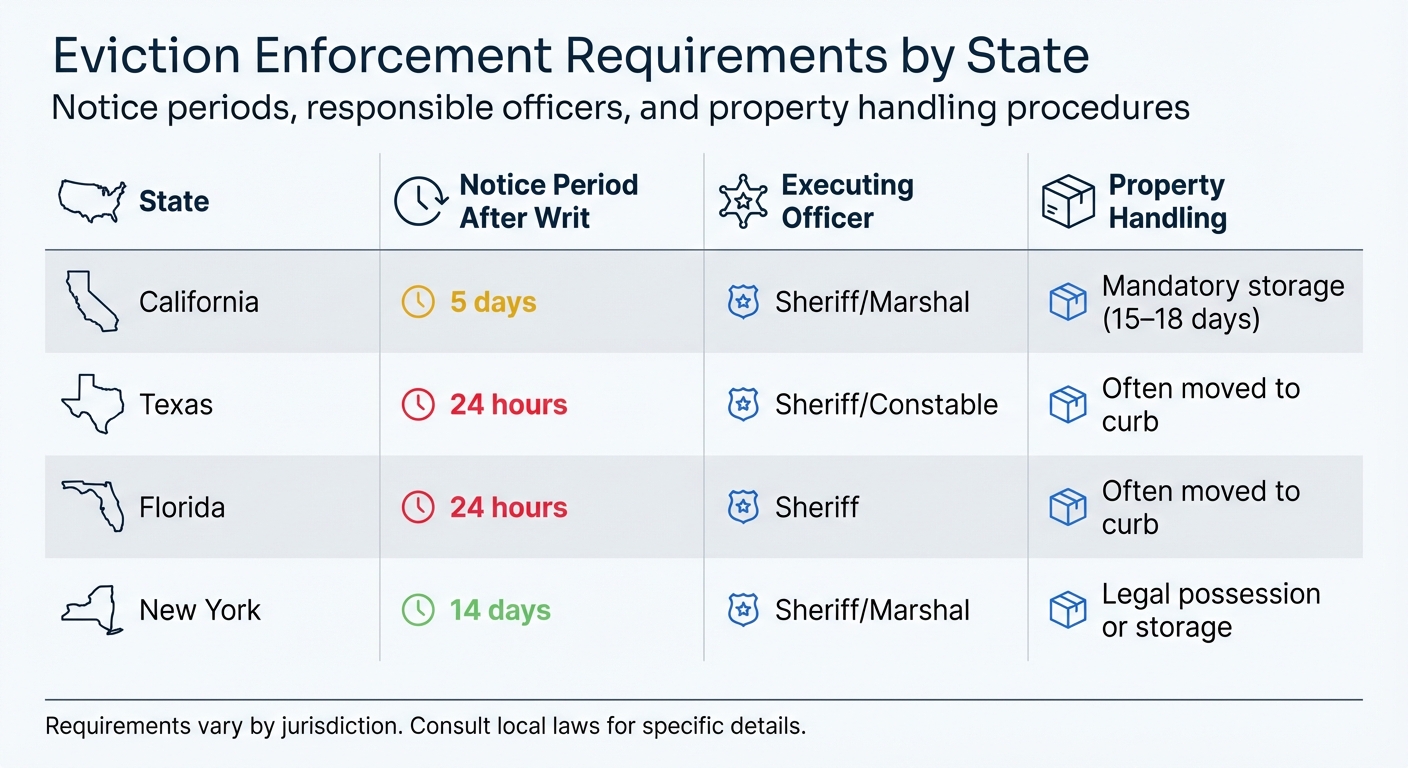 {State-by-State Eviction Notice Periods and Property Handling Requirements}
:::
{State-by-State Eviction Notice Periods and Property Handling Requirements}
:::
1. Coordinated Eviction with Advance Notice
A coordinated eviction is the most organized approach to involving law enforcement during an eviction. In this process, a sheriff or marshal carries out a Writ of Possession with proper notice and clear communication among all parties.
Notification Methods
Advance notice is the cornerstone of a coordinated eviction. Before the scheduled removal, officers serve a final written notice, such as a "Notice to Vacate" or a "72-Hour Notice" [8][3][10]. This document specifies the names of the involved parties, the property address, the eviction date and time, and includes the officer's signature [8][2]. Depending on the jurisdiction, notices may be delivered in person, posted on the property door, or sent via first-class mail [9][2][10].
The required notice period varies by state. For example, Virginia mandates 72 hours of notice before removal [8], while New York requires at least 15 days after notice service [10]. In New York, if the eviction isn’t carried out within 30 days, the notice becomes invalid and must be reissued [10].
Entry Protocols
On eviction day, the sheriff follows a specific protocol. Officers knock, announce their presence, and state their legal authority to enforce the court order [1]. This process is entirely different from illegal "self-help" evictions, where landlords bypass the law by changing locks or removing tenants without court involvement [5]. As US Law Explained states:
"The writ of possession... transforms the judge's decision into a direct order to a sheriff or constable, commanding them to physically remove the tenant and restore possession of the property to you." [5]
In the District of Columbia, landlords must ensure officers can access the property within 10 minutes of their arrival [2]. Occupants have the right to verify the officer’s identification and review the original Writ of Possession during the process [1].
Property Handling Responsibilities
When officers arrive, tenants are usually given only a few minutes to collect essential belongings [1][2]. Landlords should encourage tenants to remove critical items like medications, legal documents, and valuables ahead of time. For items left behind, local laws dictate retrieval procedures. For instance, in California, tenants have 15 days (if notified in person) or 18 days (if notified by mail) to claim their property before landlords can dispose of or sell it [3].
Timelines
Eviction timelines are tightly regulated. Once the sheriff receives the Writ of Possession and required fees - ranging from $50 to $300 depending on the jurisdiction [4] - the lockout typically occurs 7 to 14 days later [12]. Uncontested evictions generally take 5 to 8 weeks from start to finish, while contested cases can stretch to 3 to 6 months or more [12]. Factors like court delays, administrative backlogs, or weather can add time to the process. For example, in D.C., evictions are automatically postponed if it’s raining or temperatures drop below 32°F [2].
Force Usage
Sheriffs act as neutral enforcers of the court’s orders, maintaining order and ensuring the property is secured [1][5]. If occupants refuse to cooperate, officers are authorized to force entry, change locks, and remove resistant tenants [4][1][2]. Resistance can result in arrests for trespassing or obstruction of justice. The U.S. Marshals Service warns:
"Failure to comply with the orders of a Marshal during an eviction can result in arrest and prosecution." [2]
This legal framework ensures that coordinated evictions are carried out with the authority and protection of the court, unlike private eviction attempts, which can expose landlords to serious legal risks.
2. Immediate Enforcement Without Prior Notice
In some cases, law enforcement can enforce a court order with minimal or no advance notice. However, officers still need a Writ of Possession to proceed - tenants cannot be removed without this legal document. What changes is the length of the final notification period, which can be significantly shortened.
Notification Methods
In certain states, tenants may receive as little as 24 hours' notice before enforcement takes place. For instance, Texas and Florida allow sheriffs to act on writs with just a day's notice [5]. In California, tenants are typically given a 5-day Notice to Vacate before a lockout occurs [3]. In New York City, if a court-ordered stay of eviction expires or is lifted, a judge can authorize eviction without issuing a new notice, provided the warrant is executed within three business days [10]. Even in cases where a landlord’s possession judgment predates a bankruptcy filing, enforcement may proceed immediately [3].
Once the shortened notice period ends, enforcement happens without delay on the scheduled day.
Entry Protocols
On the day of the lockout, sheriffs are empowered to act quickly. If the tenant is not present or refuses to open the door, the officer can supervise as the landlord or a locksmith changes the locks to secure the property [1][3][4]. The U.S. Supreme Court addressed this in Soldal v. Cook County, ruling that removing property without a valid court order violates the Fourth Amendment:
"The Fourth Amendment protects property interests separately from privacy interests. The physical removal of the mobile home was a 'seizure' in the plainest sense of the word. Because it was done without a court order... it was unreasonable." [5]
Occupants are often given only a few minutes to collect essential items before being required to leave. After the lockout, any attempt to re-enter without permission could lead to criminal trespassing charges [1][7][11].
Property Handling Responsibilities
The sheriff's main focus is on removing individuals and restoring the property to the landlord. Handling tenants' belongings is not their responsibility [1]. What happens to these items varies by location. For example, in Detroit, landlords must place belongings in a dumpster or large container for 48 hours during an eviction, as mandated by a city ordinance [6]. Ted Phillips, Executive Director of the United Community Housing Coalition, described the situation:
"You go from all your stuff being in your house to all your stuff being in a big garbage can." [6]
In Arkansas, landlords must store tenant belongings in a safe location, such as a public warehouse, and if there’s a monetary judgment, they may sell the items to cover storage costs [13]. California law requires landlords to store items securely and provide written notice, giving tenants 15 to 18 days to retrieve their possessions [3].
Timelines
The speed of immediate enforcement varies based on local regulations and court schedules. In states with a 24-hour notice requirement, the process from the issuance of a writ to the lockout can move very quickly. For instance, in Detroit, eviction orders surged by 136% in the first four months of 2023 compared to the same period in 2022, with over 1,800 orders signed by judges [6].
| State | Notice Period After Writ | Executing Officer | Property Handling |
|---|---|---|---|
| California | 5 days [3] | Sheriff/Marshal | Mandatory storage (15–18 days) [3] |
| Texas | 24 hours [5] | Sheriff/Constable | Often moved to curb [5] |
| Florida | 24 hours [5] | Sheriff | Often moved to curb [5] |
| New York | 14 days [5] | Sheriff/Marshal | Legal possession or storage [10] |
These expedited timelines stand in contrast to jurisdictions with more extended, coordinated processes.
Force Usage
When it comes to enforcement, officers are authorized to use physical force if necessary. In Arkansas, sheriffs can remove locks or other barriers to gain entry [13]. If occupants resist, they may face charges for trespassing or obstruction [1]. However, tenants are allowed to request the officer’s identification and a copy of the Writ of Possession.
The financial burden of enforcement falls on the landlord. Sheriff service fees range from $50 to $300 [4], while in Detroit, the total cost for eviction - including court officers and equipment like dumpsters - can run between $2,000 and $3,000 per case. A single dumpster alone costs approximately $500 [6].
3. Court Officer-Led Removal with On-Site Disposal
In some areas, evictions are handled by independent court officers who oversee the process of directly disposing of tenant belongings in on-site dumpsters. This approach stands out from other methods by focusing on immediate, on-location disposal of property.
Notification Methods
In cities like New York and Boston, tenants receive formal notices before eviction. For instance, New York City marshals issue a Notice of Eviction at least 14 days prior, while Massachusetts requires a 48-hour written notice (often following Massachusetts’ probate or preforeclosure proceedings) before removal begins[10][16]. Once the notice period expires, court officers typically carry out evictions on weekdays between 8:00 a.m. and 5:00 p.m.[10][16].
Entry Protocols
When court officers arrive, they present the signed eviction order and explain the purpose of their visit. Tenants are allowed a few minutes to gather essential items like medications or important documents before the removal process begins. After the tenants leave, officers ensure the locks are changed to prevent re-entry[10]. This straightforward entry process sets the stage for the distinctive handling of tenant belongings in this method.
Property Handling Responsibilities
A defining feature of this approach is the on-site disposal of tenant belongings. For example, in Detroit, landlords are required by city ordinances to provide a large dumpster where all items are placed. This dumpster must remain accessible for 48 hours to avoid violations related to blight[6].
In New York City, court officers must create a written inventory of the removed items. However, certain belongings - like food, groceries, or fixtures that could damage the property if removed (e.g., wall-to-wall carpeting) - are excluded. If cash is found during the process, it is handed over to local police, while any living animals are referred to Animal Rescue services[10].
Timelines
The entire removal process typically takes between 20 minutes and 2 hours, depending on the volume of items to be removed[6]. However, if the tenants include elderly, disabled, or mentally ill individuals, the eviction may be delayed by up to two weeks to allow social service agencies to step in and provide assistance[10].
Detroit has experienced a sharp rise in evictions. In the first four months of 2023 alone, more than 1,800 eviction orders were signed - an increase of 136% compared to the same period in 2022[6]. These expedited timelines highlight the efficiency of this method compared to other approaches.
Force Usage
In some cities, such as Detroit, court officers are permitted to carry concealed firearms for their safety during evictions[6]. Local police are involved only to ensure peace during the process. Chief Judge William McConico of Detroit’s 36th District Court has expressed concerns about the rising risks faced by court officers:
"The threat against their [court officers'] physical safety is rising exponentially, and that cannot continue." [6]
Costs Involved
The financial burden of eviction falls entirely on landlords. According to David Jones, CEO of DLJ Properties LLC, the cost of a physical eviction in Detroit can range between $2,000 and $3,000. Dumpster rentals alone account for roughly $500 of that total[6].
Pros and Cons
Evictions come with a mix of challenges and benefits for both landlords and tenants, depending on how they're handled. Coordinated evictions that provide advance notice give tenants a chance to gather important belongings like documents, medications, and valuables before being removed [15][3]. This approach can reduce stress for tenants and help landlords avoid the steep costs associated with forced removals [15][3]. However, the downside for landlords is that the extended timeline delays their ability to regain possession of the property [3]. As David Jones, CEO of DLJ Properties LLC, points out:
"At the end of the day, it's a cheaper alternative than the bailiff and the dumpster and a clean out." [15]
On the other hand, immediate enforcement without prior notice allows landlords to reclaim their property quickly, but it comes with significant drawbacks [1]. Tenants often lose essential personal items when caught off guard, and landlords face high costs for these abrupt actions [15]. Sudden lockouts can also lead to resistance, which might escalate to criminal charges like obstruction of justice or trespassing [1][14].
Here’s a comparison of how different eviction approaches stack up:
| Feature | Coordinated (Advance Notice) | Immediate Enforcement | Court Officer-Led (On-Site Disposal) |
|---|---|---|---|
| Notification Method | Formal notice after court judgment | Knock and announce at the door | Written notice 48–72 hours prior |
| Timeline | 5 days for voluntary vacating | Immediate removal (minutes to hours) | 20 minutes to 2 hours for full removal |
| Tenant Preparation | High – time to pack and relocate | Minimal – only essential items | Minimal – belongings quickly moved to a dumpster |
| Force Usage | Minimal – relies on tenant cooperation | Sheriff may force entry and arrest resisters | Officers may carry firearms |
| Cost to Landlord | Lower if tenant leaves voluntarily | High – includes officer fees and disposal | About $2,000–$3,000 total |
These comparisons underline the operational and financial trade-offs of each eviction method. Quick removal methods may seem efficient, but they often come with steep human and monetary costs. For instance, Detroit saw a 136% surge in eviction orders during early 2023 compared to the previous year, showing how fast these situations can escalate [6]. Housing advocate Soummer Crawford sums it up well:
"It's an emotional situation. It's trauma. Nobody wins, at all." [15]
Conclusion
The day law enforcement arrives to enforce an eviction is often the culmination of careful planning and coordination. Landlords who provide proper notice and work with professional crews tend to spend less and face fewer disputes. On the other hand, tenants who cooperate and quickly gather their essential belongings can avoid further legal trouble and the emotional toll of losing their possessions. This highlights the importance of the pre-eviction strategies discussed earlier.
Landlords must strictly avoid unauthorized evictions, as these can lead to criminal or civil penalties. Instead, maintaining thorough documentation of lease violations, working with the sheriff's office, and hiring professional removal crews can help ensure the process runs smoothly [17]. Some landlords may also consider "cash for keys" agreements, which can be a less expensive alternative to the $2,000–$3,000 typically spent on court officer-led evictions [15]. Legal experts emphasize that a writ of possession is essential for law enforcement to carry out an eviction.
For tenants, seeking legal advice as soon as possible is crucial, especially since over 90% of landlords have legal representation, whereas fewer than 10% of tenants do [19]. If eviction seems unavoidable, packing essential items immediately is key, as access to the property ends once the locks are changed [6]. In cases of severe hardship, filing a stay of execution may delay removal for up to 40 days. Remaining calm and cooperative can also help prevent the situation from escalating into additional legal challenges.
Law enforcement agencies can play a role in improving outcomes by posting clear "Notice to Vacate" signs 24 hours to 5 days before the scheduled eviction, giving tenants a final chance to leave voluntarily. In areas with significant delays, programs like Georgia's HB 1203 allow landlords to hire off-duty peace officers if the sheriff cannot execute a writ within 14 days, offering a potential solution [18]. Additionally, requiring body camera usage during evictions can provide transparency and protect all parties involved [5].
In many states, including Georgia, the entire eviction process often takes one to three months, with filing fees ranging from $50 to $75 and service of summons fees between $25 and $50 [32,33]. While the process can be difficult, proper coordination can help lower costs, reduce stress, and improve safety for everyone, aligning with the strategies outlined earlier.
As Matthew Paletz, CEO of Paletz Law, puts it:
"Landlords do not want to evict their tenants. That is the last resort." [6]
FAQs
::: faq
Can I stop the eviction once the sheriff is scheduled?
Once a sheriff is set to carry out an eviction, stopping it becomes extremely challenging. The sheriff operates under a court order, like a Writ of Possession or Writ of Restitution. At this point, halting the process demands immediate legal action, but the options available are often limited and must be pursued quickly. :::
::: faq
What should I take first if I only have minutes to pack?
If you're pressed for time to pack, concentrate on the essentials you absolutely can't replace. Grab your ID, keys, important documents like birth certificates or legal papers, and any valuables. These are the items you'll need most during an eviction and should be your top priority. :::
::: faq
What happens if I try to re-enter after the locks are changed?
If locks are changed and someone attempts to re-enter without permission, it could be seen as trespassing or even an illegal lockout. In such situations, law enforcement might step in to stop any unauthorized entry. It's important to note that landlords must adhere to the formal eviction process. This means they need a court order before they can legally change the locks or block access to the property. :::

