


How to Appeal a Probate Decision in Massachusetts
If you believe a probate court decision in Massachusetts was legally flawed, you can appeal to higher courts like the Appeals Court or Supreme Judicial Court. Appeals focus on legal errors or judicial missteps - not retrying the case or presenting new evidence. Here's a quick breakdown of the process:
- Strict Deadlines: File a Notice of Appeal within 30 days of the judgment.
- Costs: Expect expenses between $12,000–$48,000, including transcript and attorney fees. Fee waivers are available for those who qualify.
- Key Steps: Assemble the trial record, write a detailed appellate brief, and prepare for oral argument.
- Odds of Success: About 15% of probate appeals are reversed, with family law cases having slightly better chances (20%–30%).
- Timeline: Appeals take months, with decisions typically issued 130 days after oral arguments.
Appeals require precision and adherence to procedural rules, making legal expertise essential. Missing deadlines or filing errors can derail your case, so careful preparation is critical.
::: @figure 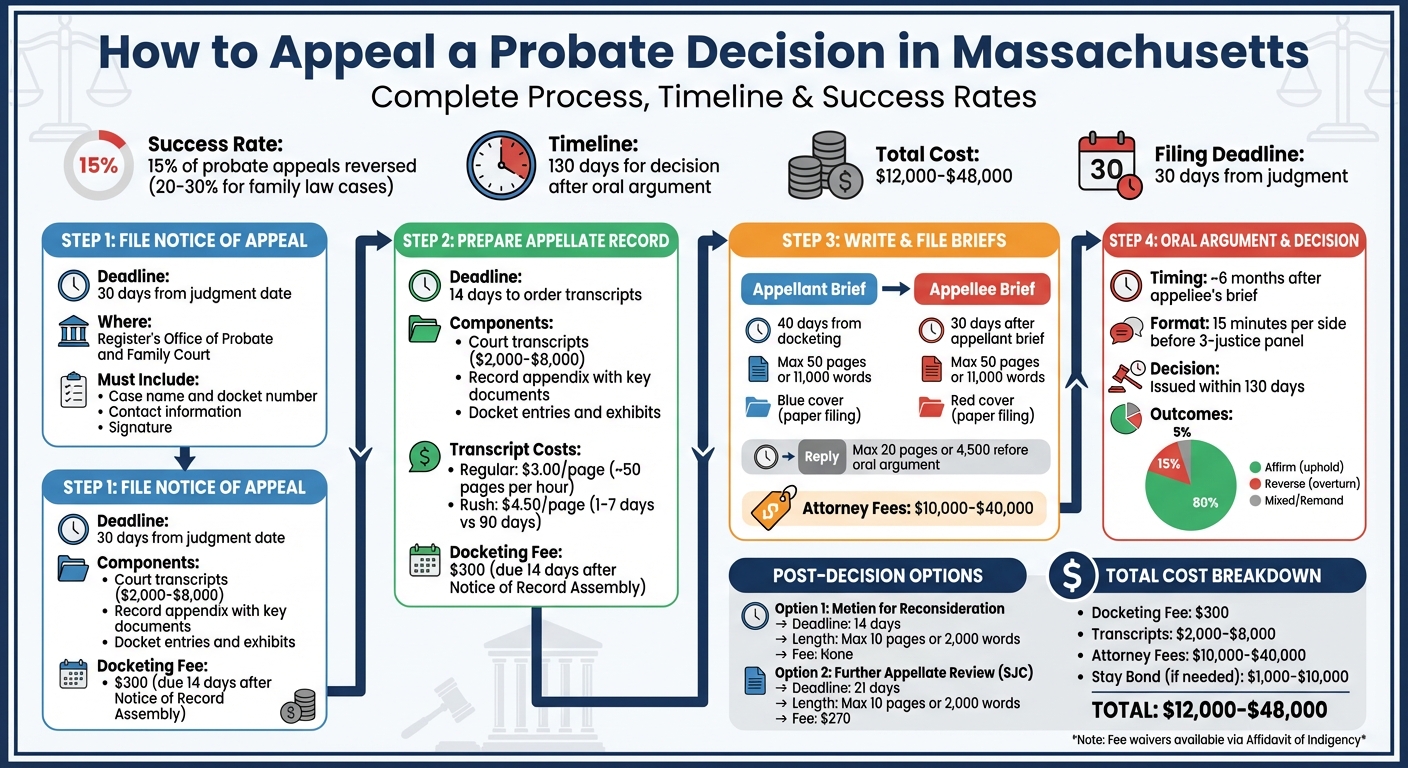 {Massachusetts Probate Appeal Process Timeline and Steps}
:::
{Massachusetts Probate Appeal Process Timeline and Steps}
:::
Probate Appeals 101
sbb-itb-fc184bb
What to Know Before Filing an Appeal
Filing an appeal can be a tough road, so it's crucial to understand what you're up against. In Massachusetts appellate courts, about 80% of trial court decisions are upheld, 15% are reversed, and 5% result in mixed outcomes. For family law cases, which often overlap with formal and informal probate matters, the reversal rate is slightly higher at 20% to 30%[3][5].
Civil appeals usually take time. After the appellee's brief is filed, it can take about six months for the case to be scheduled for oral argument or referred for a decision. Once oral arguments are complete, the court panel typically issues its decision within 130 days[7]. Beyond the odds, you'll also need to prepare for the financial and time commitments involved.
Costs and Time Requirements
The financial burden of an appeal can be significant. The $300 docketing fee is just the start. Preparing transcripts - a necessary step - can cost anywhere from $2,000 to $8,000, depending on the trial's length[5]. Attorney fees add another layer, usually ranging between $10,000 and $40,000, bringing the total estimated cost to $12,000 to $48,000[5].
If these expenses seem overwhelming, there are options. Filing an Affidavit of Indigency could waive the $300 docket fee and transcript costs[7]. However, if you’re seeking a stay of judgment, you may also need to post a bond, which can range from $1,000 to $10,000[5].
Valid Grounds for Appeal
Appeals aren’t about disagreeing with a judge’s decision - they require legally valid grounds. As Casey Lundregan Burns, P.C., explains:
Abuse of discretion means a clear error of judgment in weighing the facts. A clear error of law occurs when the court's legal conclusion is unsupported by existing law, or it applied the wrong law to the facts[1].
To break it down further, legal error happens when a judge misinterprets a statute, applies the wrong legal standard, or bases their decision on a legal conclusion unsupported by law. Abuse of discretion involves rulings that no reasonable person would make, like ignoring credible testimony or dismissing expert reports without explanation. Procedural and constitutional violations, such as failing to provide a fair hearing, also serve as valid reasons to appeal.
Keep in mind that most appeals - 60% to 70% - end with the original decision being upheld[5].
Step 1: File a Notice of Appeal
The Notice of Appeal is your formal way of letting the court know you’re challenging its decision. This document must be filed with the Register's Office of the Probate and Family Court where your case was originally heard - not with the Appeals Court [7][8]. Filing this notice is the first step in starting the appellate process. As outlined in the Massachusetts Rules of Appellate Procedure:
"An appeal permitted by law from a lower court shall be taken by filing a notice of appeal with the clerk of the lower court within the time allowed by Rule 4, with service upon all parties." [8]
You have 30 days from the date the judgment is entered on the court docket to submit this notice [4][5]. If you miss this deadline, you’ll likely lose your right to appeal. Keep in mind that the 30-day clock starts ticking from the date the judgment is officially entered in the docket - not the date the judge signed it or when you received it in the mail [4]. However, if post-judgment motions like a Rule 52b motion to amend findings or a Rule 59 motion to alter judgment are filed, the 30-day deadline resets and starts again from the date those motions are resolved [4].
Once you file the notice, the lower court begins preparing the record for the Appeals Court. This includes gathering original documents, exhibits, and transcripts [7]. Without this step, the appellate process cannot move forward. Below are the specific details you need to include in your Notice of Appeal.
What You Need to File the Notice
Your Notice of Appeal must include the following:
- Case Name and Trial Court Docket Number: Clearly identify the case and specify the judgment or order you are appealing [7][8].
- Contact Information: Provide your name, address, email, and phone number [7].
- Signature: In child welfare cases, the notice must be signed by you or your attorney. Unsigned notices will be rejected [8].
You also need to serve a copy of the notice on all parties involved [8]. After filing, you have 14 days to order transcripts of the relevant trial court proceedings and provide proof of the order to the lower court [7]. Once the record is ready, the court will issue a "Notice of Record Assembly" to the Appeals Court. From the date you receive this notice, you’ll have 14 days to pay the $300 docketing fee [2][7]. If the costs are beyond your means, you can submit an Affidavit of Indigency to request a waiver for both the docketing and transcript fees [2][7].
Step 2: Prepare the Appellate Record
Once you've filed your Notice of Appeal, your next task is to assemble a clear and complete appellate record. This record includes all the documents, transcripts, and exhibits that the Appeals Court will review. While the lower court clerk compiles the official record, you are responsible for creating a record appendix. This appendix should contain only the most relevant documents needed for your appeal.
The record appendix must include key materials like the trial court docket entries, the order or judgment being appealed, your Notice of Appeal, and any significant pleadings, exhibits, or transcript excerpts. Since the appendix is submitted alongside your appellant's brief, it's crucial to plan and organize it carefully. Arrange the documents chronologically, number the pages consecutively (e.g., RA1, RA2, etc.), and include a table of contents that lists each document and its starting page. If your case involves impounded or confidential information, create a separate volume with a cover clearly labeled "IMPOUNDED."
Here’s how to handle the transcripts and documents effectively.
How to Order Court Transcripts
If transcripts are not required - or if they’re already on file - you must file a signed statement with the lower court clerk certifying this within 14 days. Missing this deadline could jeopardize your appeal.
In Massachusetts, many probate proceedings are recorded electronically. If the "For The Record" (FTR) system was used in your case, order transcripts through the Court.fm online portal. For courts using JAVS or CourtSmart systems, place your order through the clerk's office. If you're unsure which system was used, contact the Register of Probate and submit the transcript order form.
Transcript costs vary: regular transcripts are $3.00 per page, while rush transcripts are $4.50 per page. Plan for approximately 50 pages per hour of court proceedings. Rush transcripts typically arrive within 1–7 days, while regular transcripts may take up to 90 days. You’ll need to pay a 50% deposit within 14 days or file a Motion to Waive Costs along with an Affidavit of Indigency if needed.
Assembling the Record Appendix
The record appendix is a vital part of your appeal, as it provides the Appeals Court with the key evidence needed to evaluate your case. Include only the essential documents, starting with the trial court docket, followed by the judgment or order being appealed, your Notice of Appeal, and any relevant pleadings or exhibits. Keep the documents in the same order they appeared in the trial court, number the pages consecutively (starting with RA1), and include a detailed table of contents.
Make sure to redact any Personally Identifying Information (PII), such as Social Security numbers, taxpayer IDs, financial account details, or driver’s license numbers, even if this information wasn’t redacted in the trial court. When filing electronically, submit the appendix as a separate PDF from your brief, ensuring it is text-searchable and not password-protected. Each volume of the appendix should not exceed 50 MB, and the cover must be white.
Once the lower court clerk has finished assembling the official record - usually within 21 days after receiving all transcripts or notice that none are required - you’ll receive a Notice of Record Assembly. This notice signals the next step in your appellate process.
Step 3: Write and File Appellate Briefs
Once you've completed the appellate record, the next step is crafting a brief that lays out your legal arguments, disputes the probate decision, and backs your claims with case law. To ensure your brief isn't rejected, it must comply with Mass. R. App. P. 16 and 20 formatting rules.
Your brief must follow a specific structure and include the following components in order:
- Cover page: Include case details and your contact information.
- Table of contents: List all sections with corresponding page numbers.
- Table of authorities: Provide an alphabetical list of all cases, statutes, and rules you reference.
- Statement of issues: Clearly outline each question for review.
- Statement of the case: Summarize the procedural history.
- Statement of facts: Present facts with citations to the record.
- Argument section: This is your main legal argument. Add a summary of the argument only if it exceeds 20 pages or 4,500 words.
- Relief sought: Specify what outcome you’re asking the court to grant.
- Signature: Include your name and BBO number (if you're an attorney).
- Addendum: Attach the judgment being appealed and any relevant statutes.
- Certificates of compliance and service: Confirm your brief meets the rules and has been properly served.
Every factual claim must have a citation to the record, such as "RA55" for the record appendix or "TR231" for transcript references. Using descriptive terms like "the executor" or "the guardian" instead of "appellant" or "appellee" makes your argument easier to follow. For each issue, include the applicable standard of review (e.g., abuse of discretion or error of law) to guide the Appeals Court on how to evaluate your claims. When citing Massachusetts decisions, use only the official reports (Massachusetts Reports or Massachusetts Appeals Court Reports) and include pinpoint citations to specific pages.
How to Format Your Brief
Stick to these formatting rules:
- Use 12-point Courier New with 1.5-inch side margins or 14-point Times New Roman with 1-inch margins.
- Double-space the text, except for headers, footnotes, and indented quotes.
- Print on white 8.5 x 11-inch paper in black ink.
- Number pages consecutively, starting with the cover as page 1.
For length, principal briefs are capped at 50 pages (monospaced) or 11,000 words (proportional). Reply briefs are limited to 20 pages or 4,500 words.
If filing paper briefs, use colored covers: blue for appellant briefs, red for appellee briefs, and gray for reply briefs. However, if filing electronically through eFileMA.com (required for most attorneys), color covers aren't needed. Bind paper filings securely along the left edge, avoiding industrial staples that might slow down processing. Use a method that allows the brief to lie flat.
For probate cases involving impounded information - common in matters involving minors or sensitive family issues - mark the cover with "Impounded" or "Contains references to impounded material." Refer to the redaction guidelines outlined in Step 2 for additional instructions.
Brief Filing Deadlines
Timing is critical. Here’s the timeline:
- The appellant's brief must be filed within 40 days of docketing.
- The appellee's brief is due 30 days after the appellant's brief.
- Reply briefs must be filed within 14 days of service or 7 days before oral argument, whichever comes first. These briefs can only address points raised by the appellee - you cannot introduce new issues.
Missing deadlines can jeopardize your appeal. Should you miss the 14-day docketing deadline, you'll need to file a motion to submit your brief late, along with an additional fee. Self-represented litigants may qualify for the Informal Brief Pilot Program (extended through at least June 2026), which relaxes some requirements, such as tables of contents and authorities. Contact the clerk’s office to see if you’re eligible.
Step 4: Oral Argument and the Court's Decision
After the briefs are filed, most appeals move to oral argument. Roughly two-thirds of Appeals Court cases include this step, while the remaining cases are decided based solely on the written briefs [10]. If oral argument is scheduled for your case, it will typically take place about six months after the appellee's brief is filed [7].
Getting Ready for Oral Argument
Oral argument is your chance to directly address the three-justice panel and point out any clear legal errors made by the trial court. Each side is given 15 minutes, with the appellant speaking first. In Massachusetts, rebuttals are not permitted [10][9]. Keep in mind, this is not a retrial, and no new evidence can be introduced.
Arrive early to sign the appearance form with the Session Clerk. Make sure your electronic devices are turned off before entering the courtroom [10]. Begin your argument with the formal greeting: "Members of the panel, may it please the Court", and address the justices as "Your Honor" or by name [10].
Pay attention to the podium light system: the light stays green for the first 13.5 minutes, turns yellow with 1.5 minutes remaining, and turns red when time is up. Once the red light appears, you must stop unless answering a justice's question [10]. Focus on your strongest legal arguments rather than repeating everything from your brief - the justices have already reviewed it. According to court rules, "nothing argued in the brief shall be deemed to be waived by a failure to argue orally" [9].
If your case involves impounded or confidential information, be cautious about what you disclose, as oral arguments are recorded and made public [10]. After the argument, do not submit additional briefs or letters unless the justices specifically request them or if you need to correct a factual error [9]. Recordings of the oral arguments are usually available online within 72 hours [10].
Once you've presented your case, the court will deliberate and issue its decision based on their established timeline.
What to Expect from the Court's Ruling
After the oral argument, the three-justice panel deliberates and typically releases a written decision within 130 days [7][11]. The court may choose to:
- Affirm the probate court's decision (uphold it),
- Reverse the decision (overturn it), or
- Remand the case (send it back to the probate court for further action).
The decision will outline the court's legal reasoning and indicate whether the probate court made an error or misused its discretion. Twenty-eight days after the decision is issued, the court sends out a rescript - an official mandate directing the probate court to carry out the judgment - unless you file for reconsideration or further review [11].
Options After the Appeals Court Ruling
When the Appeals Court issues its decision, you still have paths to seek further review if you're dissatisfied with the outcome. There are two main options to consider. Taking either of these steps will pause the rescript - a formal order to the probate court - ensuring the decision doesn't take effect until your request is resolved [11].
Requesting Reconsideration
One option is to ask the same panel of judges to review their decision. This involves filing a motion for reconsideration within 14 days of the Appeals Court's ruling [12]. The goal here is to highlight specific legal or factual mistakes the court may have overlooked. It's important to focus on these errors and avoid introducing entirely new arguments.
The motion must adhere to strict guidelines: it should not exceed 10 pages (if monospaced) or 2,000 words (if proportional). There are no filing fees, and all motions must be submitted electronically via the Appeals Court system - no paper copies are required. To simplify the process, you can use the "Court Forms Online" interactive tool to draft your motion.
Typically, the opposing party won't respond unless the court specifically requests it. As outlined in Appellate Procedure Rule 27, the court has discretion over the motion and may award costs, including reasonable attorney's fees, to the prevailing party [12]. Oral arguments are not part of this process unless explicitly ordered by the court.
Appealing to the Supreme Judicial Court
The other option is to seek further review from the Massachusetts Supreme Judicial Court (SJC), the state's highest court. You can file an Application for Further Appellate Review (FAR) under Rule 27.1. This must be submitted within 21 days of the Appeals Court's decision [13]. For civil cases, there is a $270 filing fee, along with a possible $22 e-filing vendor fee. Payments can be made via personal or certified check, but cash and credit cards are not accepted.
The SJC will consider FAR applications only if they raise substantial issues affecting public interest or justice [13]. Your application must include several key components: a request for leave, a summary of prior proceedings, a brief statement of facts, points for review, and your argument. Like the motion for reconsideration, this application must stay within a 10-page or 2,000-word limit. Additionally, you need to attach a copy of the Appeals Court's decision and use white covers for physical filings.
The opposing party has 14 days to file a response. Decisions on FAR applications are generally made without oral argument, and the court will only grant further review if at least three justices agree. It's worth noting that Massachusetts appellate courts uphold trial court decisions about 80% of the time, reverse them in 15% of cases, and reach other outcomes in the remaining 5% [3].
If you're pursuing FAR while a motion for reconsideration is still pending, make sure to promptly inform the Supreme Judicial Court of any updates regarding your reconsideration motion. This ensures all parties and courts are on the same page.
Mistakes to Avoid in the Appeals Process
Mistakes during the appeals process can lead to an immediate dismissal of your case. For example, missing deadlines, such as the critical 30-day window to file a Notice of Appeal, will result in automatic dismissal [14][4]. However, deadlines are just one of several hurdles that can trip up your appeal.
One common misstep is attempting to introduce new evidence during the appeal. The Appeals Court does not function as a retrial; it strictly reviews the trial court's record for legal errors or abuse of discretion. This means no new evidence, witnesses, or arguments are allowed. Another frequent error is failing to order transcripts within 14 days of filing the Notice of Appeal. Without these transcripts, the court cannot review the necessary details of your case, effectively halting your appeal [7].
Formatting errors are another pitfall that can lead to your brief being rejected outright. For paper filings, specific cover colors are required: blue for the appellant's principal brief, red for the appellee's brief, and gray for a reply brief [6]. Additionally, your brief must adhere to strict formatting rules, including font size (12-point Courier New or 14-point Times New Roman), proper margins, and the inclusion of all required sections like the "Statement of Facts" with citations and an "Addendum" containing the order being appealed [6].
Failing to redact Personal Identifying Information (PII) is a critical error as well. Supreme Judicial Court Rule 1:24 mandates that PII, such as Social Security numbers and financial account details, must be removed from all publicly accessible documents [6]. Another common oversight is neglecting the docketing statement, which must be filed within 14 days of the "Notice of Entry." Missing this step can lead to the court denying motions for extensions or stays of proceedings [7].
Avoiding these errors is crucial to presenting a strong appeal. For a quick reference, the table below outlines key deadlines and filing requirements to help you stay on track.
Deadlines and Filing Requirements at a Glance
| Stage | Deadline | Required Document/Action | Fee |
|---|---|---|---|
| Notice of Appeal | 30 days from judgment [14][4] | File in the Trial Court | Varies by court |
| Transcript Order | 14 days from Notice of Appeal [7] | Order form filed in Trial Court | Cost of transcript |
| Docketing the Appeal | 14 days from Notice of Record Assembly [7][2] | Pay fee or file Indigency Waiver | $300 [2] |
| Docketing Statement | 14 days from Notice of Entry [7] | Civil Docketing Statement | None |
| Appellant Brief | 40 days from Entry of Appeal [14][6] | Brief and Record Appendix | None |
| Appellee Brief | 30 days after service of Appellant Brief [7][6] | Appellee Brief | None |
| Motion for Reconsideration | 14 days from Appeals Court decision [7] | Written motion (max 2,000 words) | None |
| Further Appellate Review | 21 days from Appeals Court decision [13] | Application to Supreme Judicial Court | $270 [13] |
Conclusion
The appellate process is a meticulous journey that requires strict compliance with deadlines and procedures. Missing a single deadline can result in your appeal being dismissed or lead to additional costs.
It's important to note that appellate courts rarely overturn trial court decisions. This highlights the need to base an appeal on a clear legal error or an abuse of discretion, rather than simply being dissatisfied with the trial's outcome. As Casey Lundregan Burns, P.C. explains:
An appeal is not a do-over of the trial, but it is a review of the judge's rulings and use of the law [1].
Another critical aspect is adhering to the stringent formatting standards required by the Massachusetts Appeals Court. Failing to meet these requirements can result in your brief being rejected.
For real estate professionals managing probate cases, understanding the timelines and procedures of the appeals process is equally important. Access to accurate probate data, such as that provided by LeadList.Pro, can help track case statuses, monitor appeal deadlines, and determine when properties are legally ready for sale. This can save months of delays - often five to six months - that might otherwise complicate property transactions [7]. Mastering these procedural details is essential for navigating appeals effectively and for professionals dealing with probate-related property sales.
FAQs
::: faq
Can I appeal if I just disagree with the probate judge?
Yes, you can challenge a probate decision in Massachusetts, but it's important to know that just disagreeing with the outcome won't cut it. Appeals must be based on specific reasons, such as a legal error, a procedural mistake, or the discovery of new evidence. Be sure to carefully review the filing requirements and deadlines for probate appeals in Massachusetts to ensure your case is properly submitted. :::
::: faq
How do I ask the court to pause the probate order during the appeal?
To pause (stay) a probate order during an appeal in Massachusetts, you’ll need to file a motion for a stay of judgment under Rule 6 of the Massachusetts Rules of Appellate Procedure. Be sure to clearly outline the reasons why the stay is necessary in your motion. It’s a good idea to carefully review the applicable court rules and consider consulting a legal professional to ensure your filing is accurate and complete. :::
::: faq
What if I miss the 30-day Notice of Appeal deadline?
If you don't file a Notice of Appeal within the 30-day deadline in Massachusetts, your appeal might be dismissed. According to the Massachusetts Rules of Appellate Procedure, the Notice must be submitted to the clerk of the lower court within this timeframe. Missing the deadline means you can ask the court for permission to file late, but such requests are rarely approved and require demonstrating good cause. :::

