


7-Day Plan For Preforeclosure Lead Follow-Ups
Want to connect with preforeclosure leads effectively? Here’s the deal: Most sales require at least five follow-ups, but nearly half of salespeople give up after just one attempt. For homeowners facing foreclosure, a single follow-up won’t cut it. This 7-day plan ensures consistent outreach, builds trust, and positions you as a helpful resource - not just another salesperson.
Key Takeaways:
- Day 1: Send a personalized email or letter. Use warm, empathetic language and avoid foreclosure jargon.
- Day 2: Make a phone call. Introduce yourself as a local expert and ask open-ended questions to understand their goals.
- Day 3: Share a Comparative Market Analysis (CMA) and a clear foreclosure timeline to outline their options.
- Day 4: Request a 15-minute meeting to discuss solutions and build rapport.
- Day 5: Present actionable options like short sales vs. foreclosure, highlighting the pros and cons of each.
- Day 6: Address questions and share past success stories to build trust.
- Day 7: Recap the week, outline next steps, and plan biweekly follow-ups.
Quick Stats:
- Responding to leads within 5 minutes makes you 21x more likely to qualify them.
- 80% of sales happen after 5–7 follow-ups.
- Consistency and empathy are key to earning trust and helping homeowners navigate tough decisions.
This plan is designed for real estate professionals who want to stand out by offering genuine support. With accurate data and a structured approach, you can make a real difference for homeowners in distress.
::: @figure 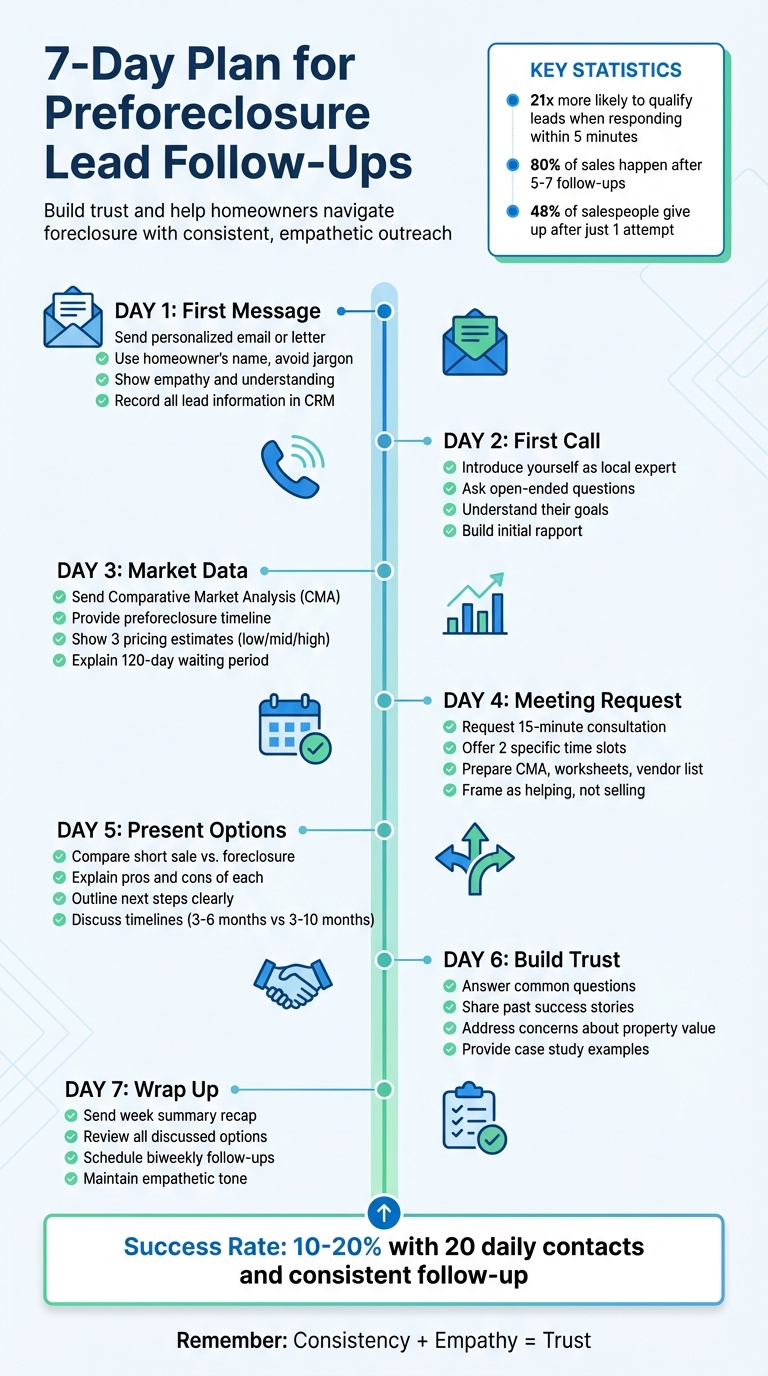 {7-Day Preforeclosure Lead Follow-Up Plan for Real Estate Agents}
:::
{7-Day Preforeclosure Lead Follow-Up Plan for Real Estate Agents}
:::
Day 1: Send Your First Message
Write a Personal Email or Letter
The first message you send is crucial - it sets the tone for all future interactions. Start by addressing homeowners by name, avoiding generic greetings like "Dear Homeowner." If there are multiple owners listed, make sure to include all their names. This small detail shows you're paying attention and not just sending out mass mailings [7].
Use warm, empathetic language to connect. Ryan David, Owner/Lead Investor at We Buy Houses in Pennsylvania, shares this advice:
"I would stress that you make it as personalized as possible. This will be very important, and getting the deal will likely hinge on properly doing it" [7].
Show understanding by acknowledging the challenges they might be facing. Position yourself as a local, trustworthy resource who can provide clear and helpful options [5][8]. Avoid using technical foreclosure terms that might confuse or overwhelm them. Instead, explain things simply, like the 120-day waiting period, and offer a no-pressure consultation where confidentiality is guaranteed [7][8]. Reassuring them that their information will remain private can go a long way in building trust [7].
Here’s a practical tip: handwrite the address on the envelope or use one that stands out visually. This small effort can make your message more likely to be opened [7]. Including professional letterhead with your contact information prominently displayed also helps establish credibility right away [7].
Once your message is sent, make sure to log all relevant details to ensure smooth follow-ups.
Record Lead Information for Tracking
After reaching out, it’s essential to keep track of everything. Record key details like the property address, the owners' names, the bank involved, and the mortgage balance in your CRM system right away [9]. If you’re using CSV files from tools like LeadList.Pro, import them into a system that allows you to track every interaction - whether it’s notes, reminders, call history, or email opens - all in one place [6][11].
For consistent results, aim to contact around 20 leads per day. This approach often delivers a success rate of 10–20% [2]. To stay on top of your follow-ups, set automated reminders and keep an eye on engagement signals, such as email opens or link clicks. These signals can guide your next steps [6]. A centralized tracking system not only helps you stay organized but also ensures compliance with regulations like TCPA and CAN-SPAM [6].
Day 2: Make Your First Phone Call
Introduce Yourself as a Local Agent
Making a phone call shifts your outreach from written communication to a real conversation. Start by introducing yourself as a local agent who knows the neighborhood well - a trusted expert in the community. Brian Icenhower, CEO of Icenhower Coaching & Consulting, explains the value of this approach:
"Agents that offer to help clients over the phone prior to a move prove that they offer a higher level of customer service in order to gain trust and build rapport" [12].
Begin the conversation with a warm, non-confrontational tone. Avoid jumping straight into topics like foreclosure. Instead, present yourself as someone offering support during challenging market conditions. For instance, you could say, "Hi, I'm [Name], a local agent specializing in this neighborhood. I've been reaching out to homeowners who might be exploring their options right now."
Use open-ended questions to guide the discussion, such as:
- "What are your goals if you could sell your property?"
- "Have you taken any steps to work with your lender?"
These types of questions let you understand their situation without making them feel pressured. Plus, the length of the conversation can often indicate how motivated the lead is - longer calls often mean they're more open to moving forward [12].
Consistency is key. Real estate agents who make about 20 calls a day typically see success rates ranging between 10% and 20% [2]. Combine persistence with genuine empathy to stand out.
Once you've built trust through a personal connection, shift the focus to your expertise in the market.
Share Property Information
After creating a sense of rapport, it’s time to share relevant property details. Mentioning specifics, like where they are in the foreclosure process or the condition of the property, can help establish your credibility [2][5]. Using tools like AI-driven distress scores can also show that you understand the urgency of their situation.
Frame the information as a way to help them. For example, you might say, "Looking at the details, your property is still in the early stages of foreclosure. This gives you more options, like negotiating with your lender or considering a short sale to protect your credit score." This approach positions you as an advisor looking out for their best interests, rather than someone just trying to close a deal [10].
During the call, offer practical, no-strings-attached resources. For example, you could:
- Refer them to a trusted lender.
- Provide a list of reliable vendors for repairs.
- Share recent sales activity in the neighborhood.
These small gestures go a long way in showing that your goal is to help, not just sell.
Keep your language simple and avoid overwhelming them with technical terms. Financial and legal topics are already daunting, so your role is to make things easier to understand. Before wrapping up, suggest a short, no-pressure consultation - about 15 minutes - to explore their options further. Position it as a chance to discuss what’s best for them, without any commitments [2][10].
Day 3: Send Market Information
Send a Comparative Market Analysis (CMA)
A Comparative Market Analysis (CMA) gives homeowners a clear picture of what their property is worth - essential information for making informed decisions.
Begin by outlining the key details of the property, like the year it was built, its size, layout, and lot dimensions [14]. Next, identify three to five comparable properties, often called "comps", that have sold within the last year in the same area [18][17]. Include a mix of recently closed sales and active listings to show homeowners both what similar properties have sold for and what they’re competing against in the current market [14].
Highlight features that influence property value, such as garage type, utility connections, views, and any HOA fees [14]. Provide three pricing estimates - low, mid, and high - to set realistic expectations [18]. Also, include neighborhood trends, like how property values have changed over the past 3, 6, and 12 months, along with the average time homes spend on the market [14]. This helps answer a critical question: "How quickly can I sell?"
Use the CMA to transition into a conversation about options like short sales, which can help homeowners and lenders avoid the full foreclosure process [10]. Brian E Adams from Hooquest explains:
"Lenders do not want to kick homeowners out! It is much more expensive to foreclose on a homeowner than it is negotiate a deal or work to catch up payments" [1].
The CMA not only clarifies the property’s value but also sets the stage for understanding the importance of acting quickly during foreclosure proceedings.
Provide a Preforeclosure Timeline
Once the homeowner understands their property’s value, walk them through when key events will occur. A clear timeline helps break the foreclosure process into manageable steps, making it less overwhelming [15]. Focus on the critical period between the Notice of Default (NOD) and the foreclosure sale - this is when the homeowner still has legal ownership and the opportunity to take action [4][11].
By federal law, lenders must wait 120 days after a payment default before beginning the foreclosure process [7]. Explain the homeowner’s right to cure the default - in many states, they can pay the overdue amount up to one business day before the sale [15].
| Stage | Maryland Timeline (Approx.) | Michigan Timeline (Approx.) |
|---|---|---|
| Default | Day 1 past due [15] | Day 2 past due [16] |
| Notice of Intent/Delinquency | Day 45 [15] | Day 45 [16] |
| Foreclosure Filing | Day 90 (Order to Docket) [15] | Day 121 [16] |
| Mediation/Workout Window | Within 25 days of final affidavit [15] | Between Day 45 and Day 121 [16] |
| Sale/Auction | 30–45 days after affidavit/mediation [15] | After 4 weeks of publication [16] |
| Redemption Period | Right to cure until 1 day before sale [15] | Typically 6 months after sale [16] |
Point out opportunities for mediation. For example, Maryland homeowners can request mediation within 25 days of receiving a final loss mitigation affidavit, with a $50 filing fee [15]. In Michigan, homeowners often have a 6-month redemption period after the sale, during which they can remain in the property and potentially repurchase or sell it [16].
Stress the cost of inaction. With over 2.1 million mortgages currently in some stage of foreclosure and another 1.8 million properties more than 90 days behind on payments, the window for action is limited [10]. The best time to act is during the period between the Notice of Default and the scheduled auction, when homeowners still have options [11]. If keeping the home isn’t feasible, listing it with an agent experienced in short sales can help protect their credit and preserve as much equity as possible [16].
Basics on How to Successfully Follow Up with Real Estate Leads
Day 4: Request a Meeting
Now that you've shared valuable market insights, it's time to take the next step: securing a face-to-face conversation.
Offer a 15-Minute Consultation
Propose a brief, no-pressure 15-minute meeting to explore potential solutions. Make it simple by offering two specific options, like: "Would Tuesday at 10:00 AM or Thursday at 2:00 PM work better for a quick 15-minute chat?" If you don’t get a response, follow up using a mix of text, email, and voicemail at different times of the day [3].
Frame the meeting as a way to protect their credit and avoid the stress of an auction. Brian Icenhower, CEO and Founder of Icenhower Coaching & Consulting, explains:
"Most of my clients tend to spend too much money in the wrong places, and I am more familiar with what buyers are looking for. So how about we schedule an appointment for me to do a quick walk‑through of your home so you know where to spend money and where not to?" [12]
This approach shifts the conversation from selling to helping, fostering trust and reducing resistance.
Highlight how this meeting could help them preserve their credit and steer clear of a public auction [13][8]. You could say something like:
"There are options I'd like to talk to you about... At least by meeting together, you will have an idea of your options before your lender takes away your property." – ProspectNow [10]
With over 2.1 million mortgages currently in some stage of foreclosure and another 1.8 million homes more than 90 days behind on payments, timing is critical [10].
Get Ready for the Meeting
Once the meeting is set, preparation becomes essential to show your professionalism and expertise. Use this opportunity to reinforce the market analysis you shared earlier and outline actionable steps.
Bring materials that establish your credibility and provide clear guidance. These might include:
- A Comparative Market Analysis (CMA) showing recent sales and pricing trends [8].
- Worksheets detailing marketing fees, commissions, and closing costs [8].
- A concise guide on foreclosure alternatives, such as short sales, loan modifications, and forbearance. Many homeowners may not fully understand how a short sale could benefit both them and their lender [10][13].
Additionally, compile a list of trusted vendors, including mortgage lenders, financial counselors, legal advisors, and contractors [8][12]. Share success stories or case studies from past clients in similar situations, focusing on outcomes like preserved equity or quick sales to build trust [8]. Finally, create a customized plan tailored to their financial situation, timeline, and unique challenges [8].
Day 5: Present Options to the Homeowner
By Day 5, the trust you've built with the homeowner becomes your foundation for helping them decide on the best financial path forward.
Compare Short Sale vs. Foreclosure
At this stage, it's essential to clearly explain the two main options available:
- Short Sale: This involves selling the home for less than the remaining mortgage balance, but only with the lender's approval. It allows the homeowner to avoid foreclosure.
- Foreclosure: Here, the lender takes possession of the property after missed payments and eventually sells it at auction.
The key difference lies in control. A short sale lets the homeowner choose the buyer and negotiate terms, while foreclosure puts the process entirely in the lender's hands, often leading to eviction. As Real Estate Skills highlights:
"Selling during pre-foreclosure gives homeowners the chance to avoid losing everything. Once a foreclosure sale happens, they're evicted, their credit is damaged for years, and they lose any potential equity."
To make things even clearer, here's a comparison:
| Option | Timeline | Pros | Cons |
|---|---|---|---|
| Short Sale | 3–6 months | Avoids foreclosure on credit report; faster credit recovery; homeowner retains some control | Requires lender approval; negotiations can take time |
| Foreclosure | 3–10 months | No need for homeowner involvement in the process | Long-lasting credit damage (7+ years); eviction is inevitable; no control |
(Source: Real Estate Skills)
Once these options are clear, you can guide the homeowner toward actionable steps that align with their choice.
Explain Next Steps
Now that the options are on the table, it's time to outline the next steps. If the homeowner opts for a short sale, assist them with gathering necessary documents, drafting a hardship letter, and listing the property on the market. For other alternatives, such as loan modifications, connect them with HUD-approved counselors who can provide additional guidance.
Reassure them that you'll handle the negotiations with the bank and keep them updated every step of the way. It's also worth mentioning that some lenders, including those tied to FHA loans, may provide relocation assistance to cover moving costs after a successful preforeclosure sale. Be transparent about timelines and costs, such as marketing fees, commissions, and closing expenses.
Your role here is to be their advocate, ensuring they feel supported and informed as they navigate these challenging decisions.
Day 6: Answer Questions and Build Trust
By Day 6, your focus should be on addressing homeowners' concerns and reinforcing their trust in you. Clear, empathetic communication is key to easing their worries and helping them feel more in control of their situation.
Address Common Questions
Many homeowners fear losing their homes and feel powerless in the process. Explain that choosing a proactive sale allows them to take control, rather than leaving the decision to the bank.
Some may believe that waiting could improve their circumstances. In these cases, clarify that selling before an auction typically leads to better financial outcomes and avoids long-term damage to their credit. As Brian E Adams from Hooquest notes:
"Lenders do not want to kick homeowners out! It is much more expensive to foreclose on a homeowner than it is negotiate a deal or work to catch up payments."
Other concerns often include property value and liens, with homeowners fearing they won’t receive enough to cover their debts. Use your Comparative Market Analysis to set realistic expectations. Show how a successful sale can resolve debts and provide a breakdown of costs, including marketing fees, commissions, and closing expenses.
By addressing these concerns, you create a foundation of trust and set the stage for sharing your track record of success.
Share Past Examples
Demonstrating your expertise with real-life examples can go a long way in building credibility. Share anonymized case studies that highlight how you’ve helped other clients in similar situations. For example, you might describe negotiating lender approval for a short sale, reducing debt, or helping someone avoid foreclosure entirely. As PropStream points out:
"By providing concrete examples, you paint a vivid picture of your expertise in action, showcasing your understanding of the complexities involved and your ability to devise solutions."
Focus on the results you’ve achieved - whether it’s the time saved, the avoidance of credit damage, or the fresh start your clients were able to achieve. Including testimonials from past clients who faced similar challenges can further reassure homeowners that they’re not alone and that you have the experience to guide them through this difficult process.
Day 7: Wrap Up and Plan Ongoing Contact
As you conclude your seven-day strategy, it’s time to tie everything together with a clear summary and a plan for future communication.
Send a Week Summary
End the week by sending a detailed summary that highlights the key points you’ve discussed and maps out the next steps.
This email or letter should recap the options you’ve explored together, such as short sales, loan modifications, or listing the property to help avoid foreclosure. Make sure to revisit important foreclosure timelines and explain the financial implications of each option. For instance, outline how a proactive sale can help settle debts and reduce credit damage compared to letting the foreclosure process run its course[7][8].
Incorporate a personalized plan that reflects their specific situation, including their timeline, the property’s condition, and their financial standing. Be upfront about potential costs, like agent commissions, marketing fees, or closing expenses. If applicable, include additional resources to support their decision-making process. Throughout the summary, maintain a tone that is empathetic and supportive to reassure them during this challenging time.
This summary isn’t just a wrap-up - it’s the foundation for ongoing support.
Schedule Biweekly Follow-Ups
Consistency is key to staying connected and continuing to provide support.
Let the homeowner know when they can expect to hear from you next. Biweekly follow-ups strike a good balance - they keep you on their radar without becoming intrusive. As Anna Scheller, CEO of Capri Temporary Housing, puts it:
"Use language that lets the prospect know you truly care about their plight"[7].
Each follow-up should bring something of value. This could mean sharing a local market update, providing links to helpful probate resources, or offering insights into comparable property values in the area. Use your CRM to schedule these check-ins and vary your communication channels to keep things fresh.
If the homeowner isn’t ready to move forward, give them some space. Pause follow-ups for 90 days, then re-engage with a gentle and understanding approach.
Conclusion
Successful preforeclosure follow-up is all about balancing a structured approach with genuine care. This 7-day plan offers a clear path to connect with homeowners during one of the toughest times in their lives - between receiving the Notice of Default and the auction date - when they still have choices to consider.
Here’s a key takeaway: acting quickly and staying consistent significantly boosts your chances of qualifying leads. Statistics show that reaching out 5 to 7 times with purpose puts you ahead of most competitors, who often give up after just one attempt[6]. As Jacob Camhi from PropertyRadar wisely points out:
"The adage 'you catch more bees with honey than vinegar' rings true... you'll be able to connect with a property owner much better if you start from a place of compassion."[5]
These insights highlight the power of persistence and empathy. Success lies in multi-channel communication - through calls, emails, texts, and even mail - while ensuring every interaction adds value. Whether it’s offering a Comparative Market Analysis (CMA), providing timeline insights, or simply answering questions clearly, your goal is to be helpful at every step.
Another crucial aspect? The quality of your data. Having accurate, up-to-date information makes all the difference. Platforms like LeadList.Pro deliver weekly preforeclosure leads in Massachusetts, complete with AI-powered distress scores, manual verification, and detailed contact information. With reliable data in hand, you can focus on what truly matters: earning trust and guiding homeowners through their options during this challenging period.
FAQs
::: faq
How can I make my follow-ups feel supportive rather than overly sales-focused?
To make your follow-ups more meaningful and supportive, start by digging into the homeowner’s situation. Look into key details like missed payments, equity levels, or upcoming court dates to shape a personalized approach. When you reach out, acknowledge their challenges and show a genuine willingness to assist - this is not the time for a hard sales pitch.
Adopt a multi-day strategy that uses a mix of communication methods, such as phone calls, emails, or even handwritten notes. The goal is to add value with each interaction. For instance, you could share useful resources like foreclosure alternatives or information about local counseling services. Keep your tone compassionate and focus on building trust rather than rushing toward a deal.
Take advantage of tools like LeadList.Pro’s AI-powered distress scores and verified contact information to refine your outreach. Addressing their specific concerns with empathy can help you establish a connection that feels both supportive and trustworthy. :::
::: faq
What’s the difference between a short sale and a foreclosure?
A short sale occurs when a homeowner, with the lender’s permission, sells their property for less than what’s owed on the mortgage. In this case, the homeowner oversees the sale process. While it does affect their credit, the impact is generally less severe compared to a foreclosure. This approach can also minimize financial losses for both the homeowner and the lender.
A foreclosure, however, happens when the lender takes legal ownership of the property after the homeowner fails to make loan payments. The property is then sold, often through a public auction, and the homeowner loses all ownership rights. Foreclosures tend to have a much greater negative effect on credit scores and stay on credit reports for up to seven years.
Essentially, a short sale gives the homeowner some control and lessens the credit damage, while a foreclosure is entirely lender-driven and comes with more severe financial and credit repercussions. :::
::: faq
What’s the best way to track and manage preforeclosure lead follow-ups?
To stay on top of your preforeclosure leads, start by keeping all your lead information in one central location, such as a CRM system or a spreadsheet. Make sure to log essential details like contact information, distress scores, notice-of-default dates, and any notes from your outreach efforts. This way, you’ll have a complete record to reference and ensure no lead gets overlooked. Setting up daily follow-up reminders - whether by phone, email, or even handwritten notes - for a seven-day period can help you maintain consistent communication.
When reaching out, follow a clear and structured approach. Show empathy for the homeowner’s situation, explain how you can assist, and propose a specific next step, such as scheduling a call or providing a market analysis. Be sure to regularly update the lead’s status (e.g., "contacted" or "awaiting response") to track your progress and refine your strategy as needed. Tools like LeadList.Pro can be a huge time-saver by offering accurate and current preforeclosure leads, complete with detailed property and contact information, so you can focus more on building meaningful connections. By staying organized, consistent, and understanding, you’ll boost your chances of turning leads into real opportunities. :::


